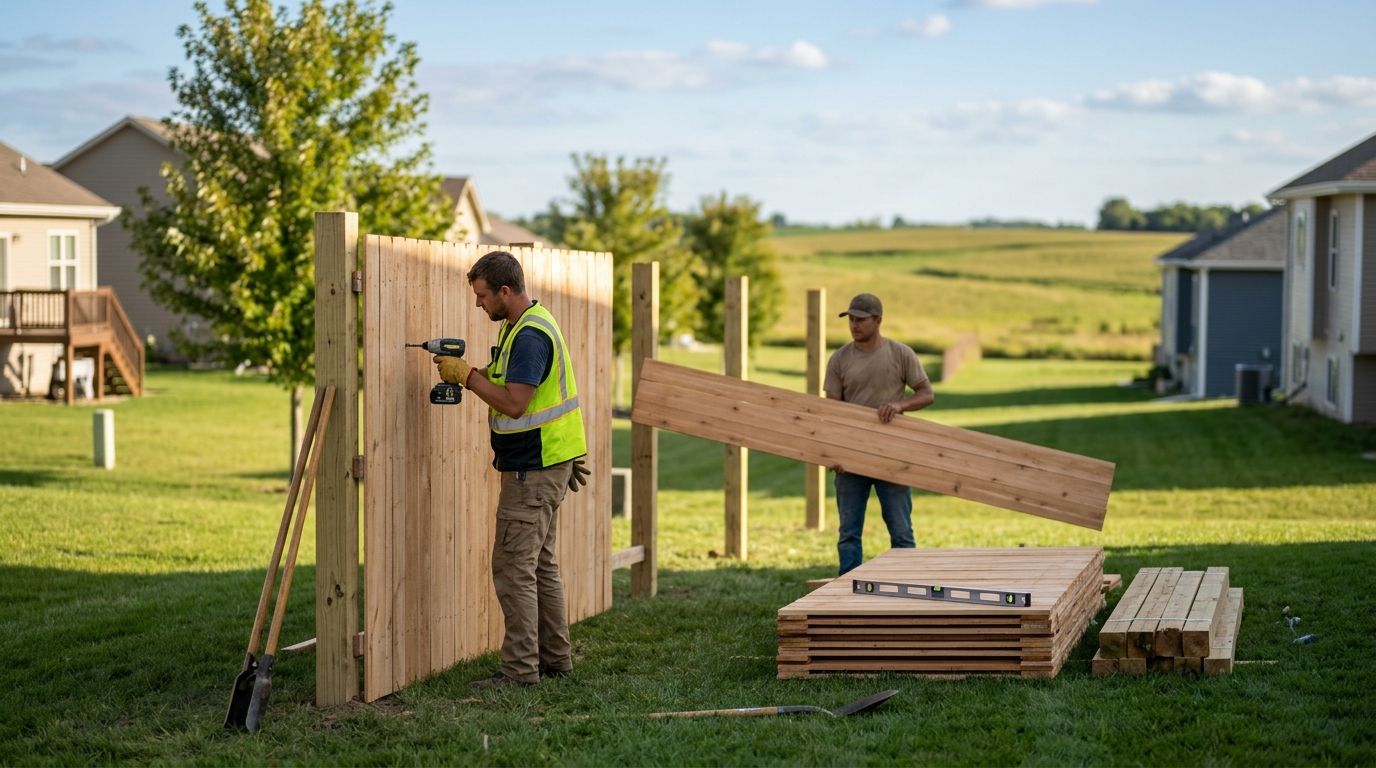
Fence installation cost in Central Iowa depends on the measured fence line, material, gates, site conditions, and work included in your written quote. For a 2026 project, compare complete installed proposals—not just a material allowance or a per-foot figure that leaves out removal, approvals, or cleanup.
- How much does fence installation cost in Central Iowa? Get a measured, itemized quote before setting your budget.
- Compare fence installation bids using the same layout, material specifications, gates, removal, and cleanup requirements.
- Choose privacy fencing for screening; choose open fencing when visibility matters more than screening.
- Phoenix Construction Solutions serves Central Iowa homeowners planning remodeling, additions, and reconstruction.
How much does fence installation cost in Central Iowa?
Your useful budget is the complete installed quote for your property, not an isolated cost per foot. A quote needs to identify what gets built, what gets removed, and which responsibilities remain yours. Without that scope, different totals do not represent the same job.
Start by defining the work in this guide to fence installation for Central Iowa backyards. Then ask every bidder to use the same fence route and specifications.
A complete 2026 fence proposal should address the following items. Treat an unlisted item as a question to resolve, not as an included service.
| Scope item | What the proposal should specify | What to clarify |
|---|---|---|
| Fence layout | Measured route, height, corners, and endpoints | Whether gates are included in the stated length |
| Materials | Fence type, posts, infill, finish, and hardware | Whether product specifications are attached |
| Installation | Excavation, post setting, assembly, and adjustments | How slopes and obstructions are handled |
| Gates | Location, opening, swing, latch, and hinges | Whether each opening suits its intended use |
| Existing fence | Removal, post extraction, and disposal | Whether buried concrete is included |
| Approvals | Applicable permit and association responsibilities | Who submits documents and obtains approval |
| Restoration | Debris removal and disturbed-area treatment | Whether seeding, sod, or planting repair is excluded |
Ask for a written total tied to that scope. If the contractor presents alternatives, request a separate description for each alternative so you can see exactly what changes.
Why this matters
A fence is both a boundary improvement and a daily-use feature. It affects how you enter the yard, move equipment, contain pets, and connect outdoor spaces.
A lower proposal is not automatically a better purchase. It can describe less work: fewer gates, a different material specification, no existing-post removal, or no restoration. Compare the work before comparing the total.
For a Central Iowa homeowner combining a fence with a deck, patio, or addition, coordination matters too. Decide where construction access and finished walkways belong before fixing the fence route.
Choose the fence function before requesting alternatives
Start with the job you need the fence to do. Screening a patio calls for a different design than marking a boundary while keeping an open view.
Material names alone are not enough. Wood fences can have different board arrangements, and metal fences can serve different purposes. Ask for a drawing or product specification that shows the proposed assembly rather than accepting a broad label.
| Option | Best for | Main advantage | Main limitation |
|---|---|---|---|
| Wood privacy fence | Homeowners who want screening and a wood appearance | Board layouts can provide visual privacy | Wood needs ongoing inspection and finish maintenance appropriate to the product |
| Vinyl privacy fence | Homeowners who want screening without a painted wood finish | Vinyl does not require the same paint or stain routine as wood | Damage repair depends on compatible components |
| Chain-link fence | Homeowners who prioritize enclosure and visibility | Open mesh preserves sightlines | Standard mesh does not provide visual privacy |
| Ornamental metal fence | Homeowners who want an open boundary with a defined appearance | Open sections preserve views | Open sections do not screen neighboring spaces |
None of these options is the automatic winner for every yard. Select the function first, then compare the proposed product, installation details, and maintenance requirements.
Privacy fencing: best for screening
Choose a privacy design when blocking sightlines is the main goal. Confirm how the proposed fence handles gaps between boards or panels, changes in grade, and the gate opening.
The trade-off is visibility. A solid boundary screens the space, but it also blocks views into and out of the yard. Check the proposed location from seating areas and windows before approving it.
Open fencing: best for visibility
Choose an open design when enclosure matters more than screening. Review the actual openings against your intended use, especially if pets are part of the decision.
An open fence is not a privacy solution simply because it defines the yard. If screening is essential, address it in the original design rather than assuming you can add another material later.
Why fence installation cost varies
For your 2026 comparison, ask bidders to explain these factors against your actual property. Each factor changes the materials, labor, or supporting work described in the proposal.
- Length and layout: The measured route establishes the amount of fencing. Corners, separate runs, and terminations also affect the assembly; lot area alone does not describe the work.
- Material and height: Identify the proposed product and finished height. Two quotes labeled privacy fence can still describe different boards, panels, posts, finishes, and hardware.
- Gates and hardware: Specify each gate opening and its purpose. A pedestrian entrance and an equipment entrance need different planning, even when both connect to the same fence.
- Ground and access: Slopes, roots, existing paving, and restricted equipment access affect how installation is performed. Ask what conditions the contractor inspected and what remains an assumption.
- Removal and restoration: Replacing a fence involves more than installing the new one. Clarify old posts, buried concrete, debris hauling, and treatment of disturbed ground.
- Approvals and location checks: Confirm applicable local requirements, recorded easements, property boundaries, and association restrictions. Assign responsibility for each check before excavation begins.
Do not assume a neighboring fence proves the correct boundary or an acceptable design. Existing improvements are not a substitute for verifying your own property conditions and applicable requirements.
How do I get comparable fence installation quotes?
Use the same information packet for every contractor. Consistency makes the differences visible and reduces the need to guess what a short proposal includes.
- Define the layout. Mark the intended route on a property drawing and identify every endpoint. Note areas where the boundary still needs verification.
- Specify the fence. State the intended function, proposed material, height, and appearance. Request the same base specification from each bidder before discussing alternatives.
- List the gates. Identify pedestrian and equipment access separately. Describe what must pass through each opening and where the gate should swing.
- Assign responsibilities. Record who handles approvals, utility coordination, removal, and restoration. Ask the contractor to identify exclusions in writing.
- Review the proposal. Compare the written scope, payment terms, change process, and completion requirements. Resolve differences before signing.
A site visit should inform the proposal, but a conversation does not replace the document. Put agreed changes into the written scope so both parties work from the same instructions.
What should I check before approving the fence route?
Check the property boundary, applicable easements, local fence requirements, and any association restrictions before authorizing installation. A utility marking request and a boundary check answer different questions; neither replaces the other.
For a 2026 project in Des Moines, Carlisle, Norwalk, Ankeny, or another Central Iowa community, ask the authority responsible for your address which requirements apply. Do not carry a height rule or approval assumption from a different city into your project.
Before digging, contact Iowa One Call through 811 and follow the current instructions for your project. Ask how privately owned lines, such as irrigation or wiring to an outbuilding, need to be addressed; do not assume every underground feature is covered by the same locating process.
Walk the proposed route with gate use in mind. Look at downspouts, drainage paths, retaining walls, planting beds, and existing hardscape. Ask how the layout avoids blocking access or interfering with drainage rather than treating those questions as installation-day decisions.
Is a per-foot fence quote enough to compare contractors?
A per-foot figure is not enough unless the included work matches. Confirm the measured fence length, whether gate openings are counted, and which installation tasks the figure includes.
Use the per-foot figure as a supporting detail, not as a substitute for the complete proposal. Separate gates, demolition, approvals, and restoration when the contractor treats them separately.
If the proposals use different measurements, ask the bidders to reconcile them against the same drawing. A calculation built on a different route is not a like-for-like comparison, even when the material name matches.
Can I reduce the scope without losing the fence's purpose?
Reduce unnecessary work before removing details that make the fence usable. Start by checking whether you need to enclose the entire yard or only screen a specific area.
A focused privacy section serves a different purpose from a complete perimeter enclosure. Compare those layouts only if both meet your goal; an incomplete enclosure is not an equivalent alternative when containment is required.
Other decisions deserve the same discipline:
- Keep gate locations tied to real walking and equipment routes.
- Choose the required privacy level instead of adding screening by default.
- Compare material alternatives using the same layout and installation responsibilities.
- Coordinate nearby construction before committing to permanent fence placement.
- Request written alternatives rather than an informal promise to simplify the job later.
Avoid treating omitted work as savings until you know who will complete it. Removing disposal or restoration from a contractor's proposal transfers that responsibility; it does not make the work disappear.
When a fence is part of a larger home project
A fence-only project needs a contractor whose written proposal expressly covers fence installation. For a broader project, establish who coordinates the fence with the remodeling or addition work.
Phoenix Construction Solutions is best for Central Iowa homeowners planning remodeling, additions, or reconstruction. The licensed and insured contractor is based in Carlisle and serves Des Moines and surrounding Central Iowa communities.
For a combined project, ask Phoenix Construction Solutions about the remodeling scope and responsibility for related exterior work. Confirm fence installation separately rather than assuming it is included. Coordinating a larger project can clarify access and sequencing, but it does not replace a fence-specific scope.
Book a Consultation
Discuss remodeling, additions, or reconstruction connected to your Central Iowa backyard plans.
FAQ
How much does fence installation cost in Central Iowa in 2026?
Fence installation cost in Central Iowa depends on the measured layout, specified materials, gates, ground conditions, and included work. Get a written installed quote that identifies removal, approvals, and restoration rather than budgeting from a material-only figure.
What's the best way to compare fence installation bids?
Compare bids against the same layout and written specification. Check gates, posts, hardware, demolition, disposal, and restoration before treating different totals as equivalent offers.
Is wood or vinyl better for a privacy fence?
Wood suits homeowners who want a wood appearance and accept its maintenance requirements; vinyl suits homeowners who want privacy without the same painting or staining routine. Compare the actual products and repair requirements, not just the material labels.
Do I need permission to install a fence in Central Iowa?
Check the requirements for your specific address before installation. Confirm local fence rules, applicable association approval, easements, and boundary information rather than assuming a neighboring fence establishes what is allowed.
Does a fence installation quote include removing the old fence?
Removal is included only when the written proposal says so. Ask whether the scope covers old panels, posts, buried concrete, hauling, and disturbed-ground treatment.
Can Phoenix Construction Solutions help with a larger home project?
Phoenix Construction Solutions is a licensed and insured remodeling, addition, and reconstruction contractor serving Central Iowa. For a project involving those services, call (515) 505-8781 at tel:+15155058781 and confirm whether related fence work belongs in the proposed scope.
One last thing
Before approving your 2026 fence layout, trace the route you use to move bulky items into the backyard. Think about a mower, outdoor furniture, and access needed for future home work.
Choose the gate around what must pass through it—not just how it looks on the drawing. Record the required clear opening and swing direction in the proposal. That small planning decision connects the fence you buy to the yard you actually use.