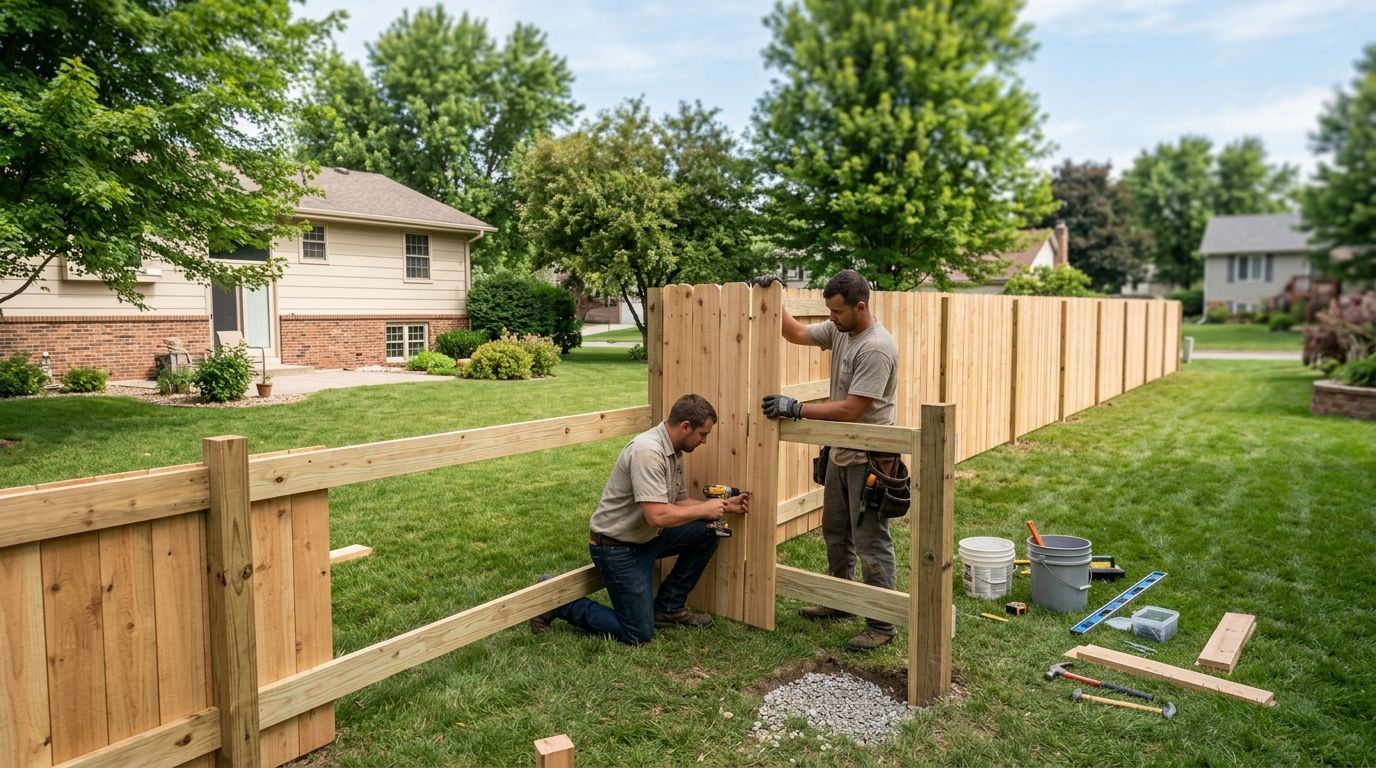
Fence installation in Des Moines starts with three decisions that have nothing to do with style: your property line, your frost depth, and your city's permit rule. Get those wrong and you're pulling posts out of the ground in April instead of enjoying a finished yard.
- Fence installation Des Moines projects require posts set below Iowa's roughly 42-inch frost line or they heave within a season or two.
- Iowa One Call requires 48 hours' notice before digging any post hole, no exceptions for DIY projects.
- Cedar and vinyl privacy fencing dominate Central Iowa backyards; chain link and split rail cost less to maintain but offer no privacy.
- Most Des Moines-area cities require a permit and a property survey before fence installation starts in 2026.
Why fence installation matters for Central Iowa backyards
A fence in Ankeny or West Des Moines has to survive freeze-thaw cycles that don't happen the same way in warmer states. Posts set at 24 inches instead of the recommended depth below the frost line will lift, lean, or snap a rail within two or three winters — that's a callback job, not a one-time install.
Backyard layout matters just as much. Central Iowa lots built in the last 15-20 years tend to run narrower, so setback rules and easements eat into usable yard space faster than homeowners expect. Before any material decision, the property line and the local permit office decide what's actually possible.
Check your property lines and HOA rules
A fence set six inches over the line is a neighbor dispute waiting to happen, and Central Iowa subdivisions enforce setback and height rules more strictly than older Des Moines neighborhoods.
- Pull a current property survey — don't rely on an old plat map from the closing packet
- Check your subdivision's HOA covenant for material and height restrictions before buying anything
- Confirm utility easements along the back or side lot lines
- Call Iowa One Call at 811 at least 48 hours before any digging
- Photograph existing stakes or markers before work starts, in case a dispute comes up later
Pick a fence material for Iowa weather
Wood, vinyl, aluminum, and chain link all behave differently through a Central Iowa winter, and the choice affects both the install and the next 15-20 years of upkeep.
- Cedar holds up to freeze-thaw cycles better than pressure-treated pine and takes stain evenly
- Vinyl needs zero staining or sealing but can crack in a hard cold snap if it's a thin-gauge product
- Aluminum and wrought-iron styles resist rot entirely but cost more per linear foot to install
- Chain link is the cheapest option to install and maintain, with zero privacy
- Split rail works for property-line definition on acreage lots, not for security or privacy
Set posts below the frost line
This is the single most common failure point in DIY fence installation across Central Iowa. Posts set too shallow will heave every spring as the ground thaws.
- Dig post holes to roughly 42 inches, below the regional frost line, not just "deep enough to feel solid"
- Use concrete footings rather than tamped dirt for any fence over 4 feet tall
- Space posts no more than 8 feet apart for wood panel fencing
- Check each post with a level before the concrete sets, not after
Get the required permits
Most cities across the Des Moines metro require a permit before fence installation, and skipping it can mean a stop-work order mid-project or a forced teardown at resale.
- Confirm permit requirements with your specific city — Ankeny, Waukee, and Urbandale each set their own rules
- Submit your property survey along with the permit application
- Check height limits — many Central Iowa cities cap backyard fences at 6 feet
- Review the building permits in Iowa process before you schedule any contractor
Choose a fence style for privacy vs. curb appeal
A front-yard fence and a backyard privacy fence solve different problems, and Central Iowa homeowners often need both styles on one property.
- Solid privacy panels for backyards that back up to another lot or a busy street
- Semi-private lattice-top styles where full privacy isn't required but sightlines still matter
- Shorter picket or split rail styles for front yards where local codes cap height
- Decorative aluminum for pool enclosures, which many Iowa cities require by code
Hire a licensed contractor or DIY
DIY fence installation saves labor cost but shifts the frost-line and permit risk onto you. A licensed, insured general contractor carries that risk and has already dealt with the local permit office.
- DIY works for short runs of split rail or chain link on flat, easy-access lots
- Hire out any job requiring concrete footings deeper than 36 inches
- A contractor already familiar with Ankeny, Waukee, or West Des Moines permit offices moves faster through approval
- Phoenix Construction Solutions handles backyard construction across Central Iowa, including hardscape and structural work tied to fence and yard projects
Budget for gates and hardware
Gates take more abuse than fence panels — they're the part that gets slammed, dragged through snow, and leaned on by dogs.
- Size at least one gate wide enough for a mower or wheelbarrow, ideally 4 feet or more
- Use galvanized or stainless hardware — standard steel hinges rust within a season in Iowa humidity
- Add a self-closing latch if the yard has a pool or small kids
- Plan a double-wide gate section if equipment or a trailer needs yard access
Schedule around Iowa's building season
Ground that's still frozen in March can't be dug, and contractors book solid through late spring across Central Iowa.
- Book fence installation in late winter for an early spring install slot
- Avoid scheduling during the peak deck and patio season (May through July) when crews are backed up
- Confirm the contractor's timeline accounts for permit review time, which adds 1-3 weeks in most cities
Fence material comparison for Central Iowa
| Material | Best for | Key limitation |
|---|---|---|
| Cedar privacy | Backyard privacy on typical suburban lots | Needs re-staining every few years |
| Vinyl | Low-maintenance privacy, no painting | Thin-gauge product can crack in hard cold |
| Aluminum/wrought iron | Pool enclosures, decorative front yards | Higher install cost per linear foot |
| Chain link | Budget property-line marking, pets | No privacy, minimal curb appeal |
| Split rail | Acreage and rural-style lot definition | No privacy or security function |
Cedar privacy fencing is the default choice for backyard privacy in Central Iowa, and vinyl wins on long-term upkeep if the upfront look matters less than avoiding maintenance.
Common mistakes Central Iowa homeowners make
- Setting posts at 24-30 inches instead of below the frost line, leading to heaving by year two or three
- Skipping the Iowa One Call before digging, which risks hitting a gas or utility line
- Guessing at the property line instead of pulling a current survey
- Ignoring HOA height and material rules that get flagged during a home sale
- Under-sizing the gate, then re-cutting posts later to fit a mower or trailer through
Planning backyard work in Central Iowa?
Licensed and insured across Des Moines, Ankeny, Waukee, and Urbandale.
A finished fence rarely stands alone — most Central Iowa homeowners tackle it alongside a deck builders in Des Moines project or another backyard upgrade in the same season, since permit review and site prep overlap.
FAQ
How much does fence installation cost in Des Moines?
Cost depends on material, fence height, and total linear footage, and varies enough by project that a site-specific quote is the only accurate figure. Get exact numbers from a licensed local contractor rather than a national average.
Do I need a permit for fence installation in Central Iowa?
Most cities across the Des Moines metro, including Ankeny, Waukee, and Urbandale, require a permit before fence installation begins in 2026. Requirements and height limits vary by city, so check with the local building office before ordering material.
How deep should fence posts go in Iowa?
Fence posts in Central Iowa need to sit below the regional frost line, roughly 42 inches, to avoid heaving through winter freeze-thaw cycles. Shallower posts commonly lean or lift within two to three seasons.
Is vinyl or wood better for a Central Iowa fence?
Vinyl needs no staining or sealing and holds up well against moisture, while cedar handles temperature swings better than treated pine and takes a stain finish evenly. The choice comes down to whether upfront cost or long-term maintenance matters more to you.
Can I install a fence myself in Iowa?
DIY works for shorter runs of chain link or split rail on flat, easy-access lots, but any fence needing concrete footings below 36 inches is harder to get right without equipment. Iowa One Call still requires 48 hours' notice before you dig, DIY or not.
What height fence is allowed in Des Moines-area backyards?
Many Central Iowa cities cap backyard fences around 6 feet, with lower limits often applying to front yards. Confirm the exact limit with your specific city before ordering material, since rules differ across the metro.
How wide should a fence gate be?
Size at least one gate to 4 feet or wider so a mower, wheelbarrow, or trailer can pass through without re-cutting posts later. A double-wide gate section makes sense if larger equipment needs yard access.
When is the best time to schedule fence installation in Central Iowa?
Late winter booking for an early spring install avoids the May-through-July rush when deck and patio crews are backed up across the metro. Frozen ground in early spring also delays digging, so timing the permit process ahead of the thaw matters.
One last thing
The detail homeowners skip most often isn't the fence at all — it's the gate hardware. A standard steel hinge left exposed through one Iowa winter starts rusting, and a fence that looks finished in October can have a stuck, groaning gate by March. Galvanized hardware costs little more upfront and outlasts the panels around it.