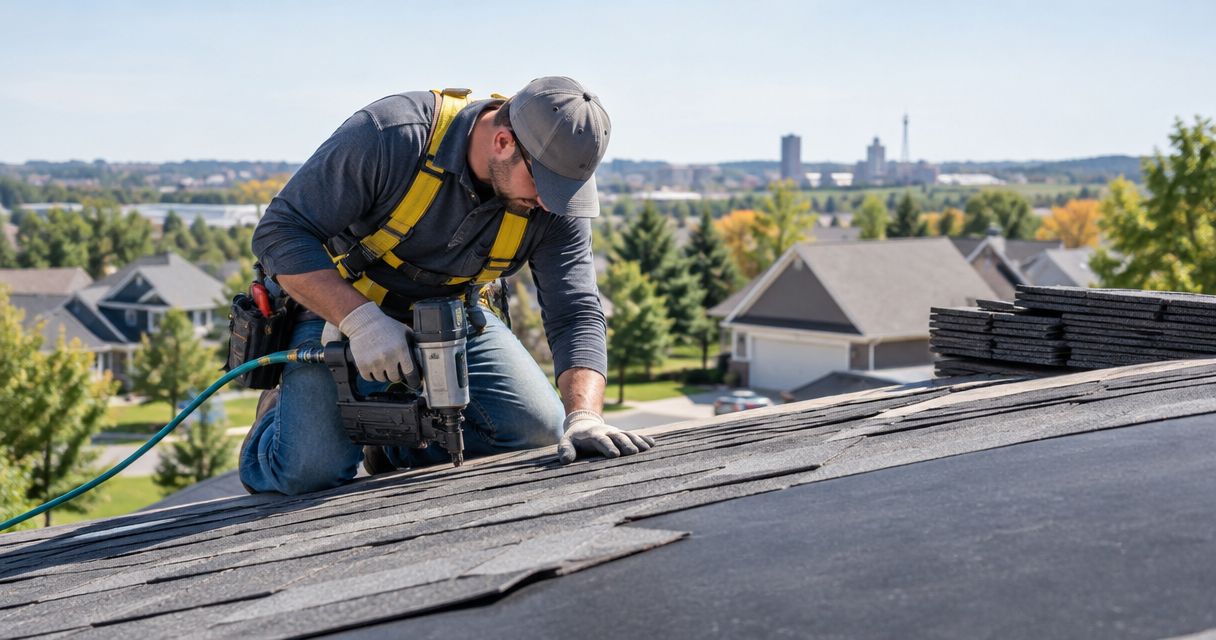
A roof replacement in Central Iowa needs a property-specific written estimate in 2026: roof area, material, tear-off, access, and repair work determine the total. Hidden decking damage and related interior repairs belong in separate, clearly defined allowances or change orders. Compare complete replacement scopes—not just the number at the bottom of each bid.
- How much does a roof replacement cost in Central Iowa? Get a measured, written estimate—not a house-size guess.
- Compare tear-off, decking repairs, flashing, ventilation, disposal, and exclusions before choosing a roof replacement bid.
- Phoenix Construction Solutions is licensed and insured for Central Iowa remodeling, additions, and reconstruction.
How much does a roof replacement cost in Central Iowa?
Your roof replacement total should reflect the measured roof and the work required to install the specified roofing system. A home's interior floor area is not its roof area: slope, overhangs, dormers, and attached structures change the measurement. For a 2026 project, ask for a current proposal based on an inspection rather than a general online estimate.
Start with this breakdown when reviewing roof replacement services for Central Iowa homeowners. Each line should identify what the contractor includes and how additional work receives approval.
| Scope item | What the written estimate should identify | What to question |
|---|---|---|
| Roof measurement | Roof surface area and included structures | A calculation based only on interior floor area |
| Tear-off | Removal of existing roofing and disposal | Unclear treatment of additional layers |
| Decking | Inspection and handling of damaged roof sheathing | Repairs with no written authorization process |
| Roofing system | Named material and installation components | A material description without product details |
| Flashing and penetrations | Work around walls, chimneys, pipes, and other transitions | Whether existing flashing stays or gets replaced |
| Ventilation | Existing conditions and proposed changes | An undefined instruction to improve ventilation |
| Site work | Protection, access, cleanup, and debris removal | Exclusions that leave cleanup to you |
| Administration | Permit responsibility and applicable inspections | An assumption that someone else handles approval |
A complete bid makes uncertainty visible. A short proposal that omits decking, flashing, or disposal does not establish that those items are included.
Why this matters
Two roof replacement proposals can describe different jobs even when both say complete replacement. One includes removal and replacement of specified flashing; another leaves existing flashing in place. Comparing their totals without checking that difference tells you little about the work you are buying.
The same issue applies in Des Moines, Carlisle, Ankeny, Waukee, and other Central Iowa communities. Confirm the requirements for your property's jurisdiction instead of assuming a nearby city's process applies. Your 2026 contract should identify who checks permit requirements and who schedules any required inspections.
Why roof replacement estimates vary
These six factors explain the scope differences you need to resolve before signing. Ask the contractor to connect each factor to a visible condition, a measurement, or a specified product.
- Roof area and shape. More surface area requires more roofing. Valleys, dormers, hips, and intersecting roof planes add cutting and detailing that a simple footprint does not capture.
- Slope and access. Steep surfaces, height, limited staging space, and difficult access affect how crews move materials and protect the property. Ask how the proposal accounts for those conditions.
- Existing roofing. The number and condition of existing layers affect removal and debris handling. The bid should state what the contractor expects to remove.
- Decking condition. Roof sheathing supports the roofing system. Ask how the contractor will document and obtain approval for damaged decking discovered during tear-off.
- Materials and details. The roof covering, underlayment, edge details, flashing, and ventilation form a system. A material name alone does not define the installation.
- Related repair work. Water-damaged framing, insulation, ceilings, or wall finishes are separate scope decisions. Identify whether the roof proposal includes them or excludes them.
None of these factors justifies an unexplained adjustment. Ask for the condition, the proposed work, and the approval method in writing.
How do contractors measure a roof replacement?
Roofing uses surface area, not living area. One roofing square equals 100 square feet of roof surface; a proposal using squares should make that unit clear. Ask whether the stated quantity represents measured coverage or the material order, which also accounts for cuts and waste.
Pitch describes slope. A 4:12 pitch means the roof rises 4 inches for every 12 inches of horizontal run. That relationship explains why a sloped roof's surface area differs from its horizontal footprint; it is not a measurement of your particular home.
Ask whether the measurement includes the garage, porch, addition, and any separate structures you want covered. For an attached addition, identify the tie-in to the existing roof. A bid that leaves out an included structure is not directly comparable with one that covers it.
What should you check before accepting a roof replacement bid?
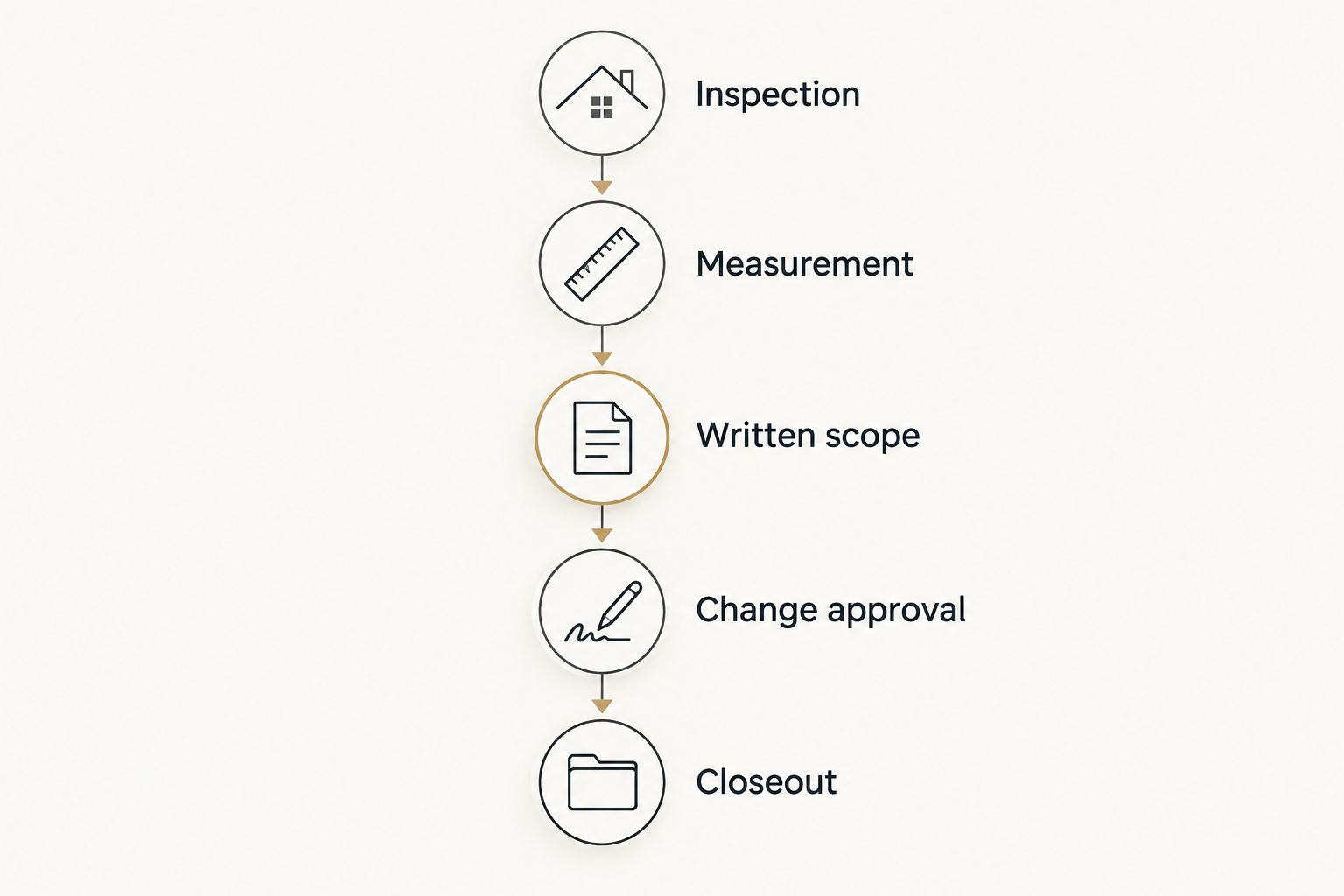
Use the same sequence for every contractor. It keeps your decision focused on documented work rather than presentation or a single total.
- Inspection. Ask what the contractor inspected and which areas remain concealed. Request photographs of visible damage and a description of unresolved conditions.
- Measurement. Confirm the roof area, included structures, and unit of measurement. Ask the contractor to explain any substantial quantity difference between proposals.
- Written scope. Identify removal, materials, flashing, ventilation, protection, cleanup, and exclusions. Resolve vague phrases before signing.
- Change approval. Establish how hidden damage will be documented and approved. The agreement should distinguish authorized repairs from work already included.
- Closeout. Ask what completion documentation, inspection records, and warranty information you will receive. Keep these with the signed agreement and approved changes.
For a 2026 replacement, make sure the proposal identifies the actual products being offered and any proposed substitutions. Do not treat an unspecified equivalent as a complete material selection. A substitution deserves review before installation, not an explanation afterward.
An inspection establishes what is visible; it does not expose every concealed layer. That limitation is a reason to define a repair process, not a reason to accept an open-ended agreement. Ask who contacts you, what evidence you receive, and how you authorize the work.
Is a roof repair better than a full replacement?
Choose the scope that addresses the documented condition. A repair targets a defined problem; a full replacement removes and replaces the roofing across the agreed area. Neither decision should rest on a stain inside the house without investigating its source.
| Approach | Best for | Benefit | Limitation |
|---|---|---|---|
| Targeted repair | A documented, localized defect with a suitable repair method | Limits work to the identified problem | Does not renew the rest of the roof |
| Full replacement | Conditions requiring renewal across the agreed roof area | Allows inspection of decking exposed by tear-off | Creates a larger project and potential concealed-repair decisions |
| Coordinated reconstruction | Roof damage accompanied by framing or interior damage | Brings connected repairs into a defined project scope | Requires clear boundaries between exterior and interior work |
Ask the inspector to explain why the recommended approach addresses the damage. If repair is rejected, request the reason. If replacement is recommended, ask which roof areas require it and whether related repairs are included.
Do not confuse a new roof covering with a repaired building interior. Wet insulation, damaged framing, and stained ceilings need their own assessment and scope. Covering the roof does not automatically resolve those conditions.
How do you compare bids without overlooking exclusions?
Put the proposals side by side and mark every difference in measurement, products, removal, flashing, ventilation, and cleanup. Then ask each contractor to clarify the missing items in writing. You need matching assumptions before comparing totals.
The benefit of an itemized proposal is visibility; its limitation is that detail alone does not prove good installation. Pair the scope review with credential checks and a clear contract. This guide to comparing bids from Central Iowa remodeling contractors covers the broader comparison process.
Before approving a bid, resolve these questions:
- What exactly stays in place, and what gets removed?
- Which products and components are specified?
- What conditions trigger additional repair work?
- Who approves changes before work proceeds?
- What is excluded from the agreement?
For your 2026 records, retain the signed proposal, product selections, photographs, approved changes, and completion documents together. That file gives you a clear account of the work rather than a collection of disconnected messages.
Does homeowners insurance cover roof replacement?
Coverage depends on your policy and the insurer's determination of the cause and extent of damage. A contractor's replacement recommendation does not establish insurance coverage. Keep the construction scope and the coverage decision separate.
Document damage before repairs when it is safe to do so, and follow your insurer's instructions for reporting a claim. Do not climb onto a damaged roof to collect photographs. Ask the insurer what documentation it needs and what emergency measures your policy requires.
If the insurer's scope and the contractor's scope differ, identify the specific disputed work. Request supporting photographs, measurements, and descriptions. Avoid treating an unresolved coverage question as permission to leave the construction agreement unclear.
When should roof work connect with remodeling or reconstruction?
Roof damage deserves a broader discussion when it affects framing, insulation, ceilings, or a planned addition. The useful question is not simply who installs the roof covering; it is who is responsible for each connected repair. Keep those responsibilities explicit.
Phoenix Construction Solutions is best for Central Iowa homeowners seeking a licensed and insured remodeling and reconstruction contractor. Based in Carlisle, the company serves Des Moines and surrounding communities, including Norwalk, Pleasant Hill, Ankeny, Urbandale, Waukee, and West Des Moines.
For a roof-related reconstruction discussion, describe the exterior damage, affected interior rooms, and any planned remodeling. Phoenix Construction Solutions handles remodeling, additions, and reconstruction; ask which parts of your particular project fit its scope. Do not assume that every related trade or repair is included without a written agreement.
Discuss Your Reconstruction Project
Book a Consultation about remodeling, additions, or reconstruction in Central Iowa.
FAQ
How much does a roof replacement cost in Central Iowa in 2026?
A Central Iowa roof replacement requires a property-specific written estimate based on roof area, materials, removal, access, and repair needs. Compare complete scopes and clarify hidden-damage approval before accepting a proposal.
Can I use my home's square footage to estimate my roof?
Your home's interior square footage is not its roof surface area. Slope, overhangs, dormers, and attached structures change the measurement, so request a roof-specific calculation.
What does a roofing square mean?
One roofing square equals 100 square feet of roof surface. Ask whether the proposal's quantity describes measured coverage or the material order, including cuts and waste.
Does roof replacement include damaged plywood underneath?
Decking replacement is included only to the extent stated in your agreement. Ask how concealed damage will be photographed, documented, and approved after tear-off.
Should I choose the lowest roof replacement bid?
Choose a bid after comparing its scope, exclusions, specified materials, and change process with the other proposals. A lower total does not establish that the proposals include the same work.
Do I need a permit to replace a roof in Central Iowa?
Confirm permit requirements with the building department responsible for your property. The written agreement should identify who obtains any required approval and coordinates inspections.
Who can I call about roof-related reconstruction in Central Iowa?
Call Phoenix Construction Solutions at (515) 505-8781 to discuss reconstruction connected with your project. The licensed and insured Carlisle-based contractor handles remodeling, additions, and reconstruction throughout Central Iowa; confirm the specific work during your consultation.
One last thing
Ask what happens after the old roofing comes off. That question tests whether the proposal addresses the moment concealed decking becomes visible. A useful answer explains documentation, temporary protection, your approval, and how the repair joins the original agreement.
Before signing in 2026, ask the contractor to walk through that process using your actual contract. If the answer depends on an unwritten understanding, put it into the agreement first. Clear decisions before tear-off are more useful than explanations after the work is finished.