

Instead of chasing loan paperwork, contractor invoices and start dates separately, build a home equity loan draw schedule construction worksheet that connects released funds to written payment milestones. For your 2026 Central Iowa remodel, first confirm whether your lender provides a lump sum, a credit line or construction draws; then coordinate the funding rules, permits and site readiness before first framing day.
- A home equity loan draw schedule construction plan starts by confirming how your lender releases funds.
- Home equity loans generally fund as a lump sum; construction loans can require milestone-based draws.
- Match contractor payment milestones to funding access, not the loan approval date.
- Phoenix Construction Solutions handles Central Iowa remodeling, additions and reconstruction; ask about scope and payment milestones.
Why this matters
Loan approval is not permission to start framing. You need usable funds, an agreed construction scope and the approvals required for the work. A lender's approval letter does not replace a building permit or settle the contractor's payment terms.
Phoenix Construction Solutions is a licensed and insured contractor based in Carlisle, serving Des Moines and Central Iowa. Its work includes kitchens, bathrooms, basements, home additions and reconstruction.
Phoenix Construction Solutions is a fit for Central Iowa homeowners planning remodeling, additions or reconstruction. Its role is construction, not determining your loan's disbursement rules. Confirm those rules directly with your lender.
For a 2026 project, keep the financing schedule and construction schedule connected but separate. One records when you can access money; the other records when work is ready to proceed. Combining them without identifying the differences creates payment commitments that funding cannot yet support.
Before you start
- Collect the funding documents. Obtain the loan agreement, closing instructions and the lender's written explanation of disbursement conditions. Identify the person who can answer release questions, not just application questions.
- Collect the construction documents. Have a proposed scope, plans where needed, payment milestones and a list of unresolved selections. Identify who handles permits and who confirms inspections with the local authority.
- Check the funding mismatch. A standard home equity loan generally provides a lump sum, not inspected construction draws. A contractor's progress-payment schedule does not automatically become a lender-approved draw schedule.
Create a shared project folder for the 2026 remodel. Keep 3 core records there: the funding agreement, construction agreement and payment tracker. Supporting documents belong beside them so you can trace each payment to its contractual milestone and any lender requirement.
Do not send account credentials to the contractor. Share the funding conditions relevant to the work, while keeping banking access and unrelated financial documents private.
Funding setup
Identify your actual funding method
- Read the signed loan documents. Find the sections explaining disbursement, borrower conditions and access to funds. Do not substitute a verbal description from the application stage.
- Ask the lender to classify the release method. Confirm whether you receive loan proceeds together, request advances from a credit line or submit construction draw requests.
- Record remaining conditions. List anything required before money reaches the account you will use to pay the contractor. Ask whether any applicable cancellation period or closing condition affects release.
- Obtain written confirmation. Save the lender's answer with the agreement and record the contact responsible for resolving funding questions.
Expected result: You know what event makes funds usable and whether later payments require lender review. That distinction controls the rest of your workflow.
Compare the payment workflows
The funding method determines who authorizes access to money. The construction agreement determines when the contractor earns payment. Neither document should be treated as a substitute for the other.
| Funding method | Best for | How funding works | Practical advantage | Limitation to resolve |
|---|---|---|---|---|
| Home equity loan | Homeowners funding a defined remodeling scope with a lump-sum loan | Proceeds generally arrive as a lump sum after closing requirements are satisfied | You can organize contractor payments without requesting a lender draw for every milestone | You must manage the proceeds and preserve funds for later work; your home secures the debt |
| Home equity line of credit | Homeowners who need access to funds at different project stages | You request advances under the credit-line agreement | Access can follow project spending rather than a single disbursement | Access remains subject to account terms; borrowing against your home carries repayment risk |
| Construction loan with draws | Projects financed through a lender-controlled construction process | Releases follow the lender's draw conditions | Required documentation connects releases to the lender's review process | Required inspections or missing documents can hold up a release; check the security and repayment terms |
These are general financing distinctions, not a recommendation to borrow. Your signed agreement controls the actual release process. Ask your lender to explain any requirement you cannot identify in the documents.
Payment schedule configuration
Build a milestone tracker
- Copy milestones from the construction agreement. Use the exact work descriptions agreed with the contractor. Do not replace a measurable milestone with a vague phrase such as progress made.
- Create 6 tracker fields: Milestone, Payment due, Funding source, Required evidence, Approval owner and Release status. These are worksheet labels you create, not lender portal settings.
- Separate contract evidence from lender evidence. Record what establishes that a contractor payment is due, then record any additional evidence the lender requires to release funds.
- Assign an owner to each action. Identify who submits documents, who schedules any required inspection and who confirms payment receipt.
- Review the sequence together. Resolve any milestone that becomes payable before you can access the funding intended for it.
Expected result: Each planned payment has a defined trigger, a funding source and a person responsible for the next action. An empty evidence field becomes a question to settle before work starts.
Do not invent a standard payment percentage. There is no universal allocation that fits every kitchen remodel, basement finish or addition. Use the agreed terms and verify that they work with your financing.
Reconcile the 2026 funding and work sequence
For each payment, follow this sequence: Work milestone, Evidence check, Funding release, Payment record. With lump-sum funding, the funding-release check means confirming that enough usable proceeds remain; it does not mean requesting a new bank draw.
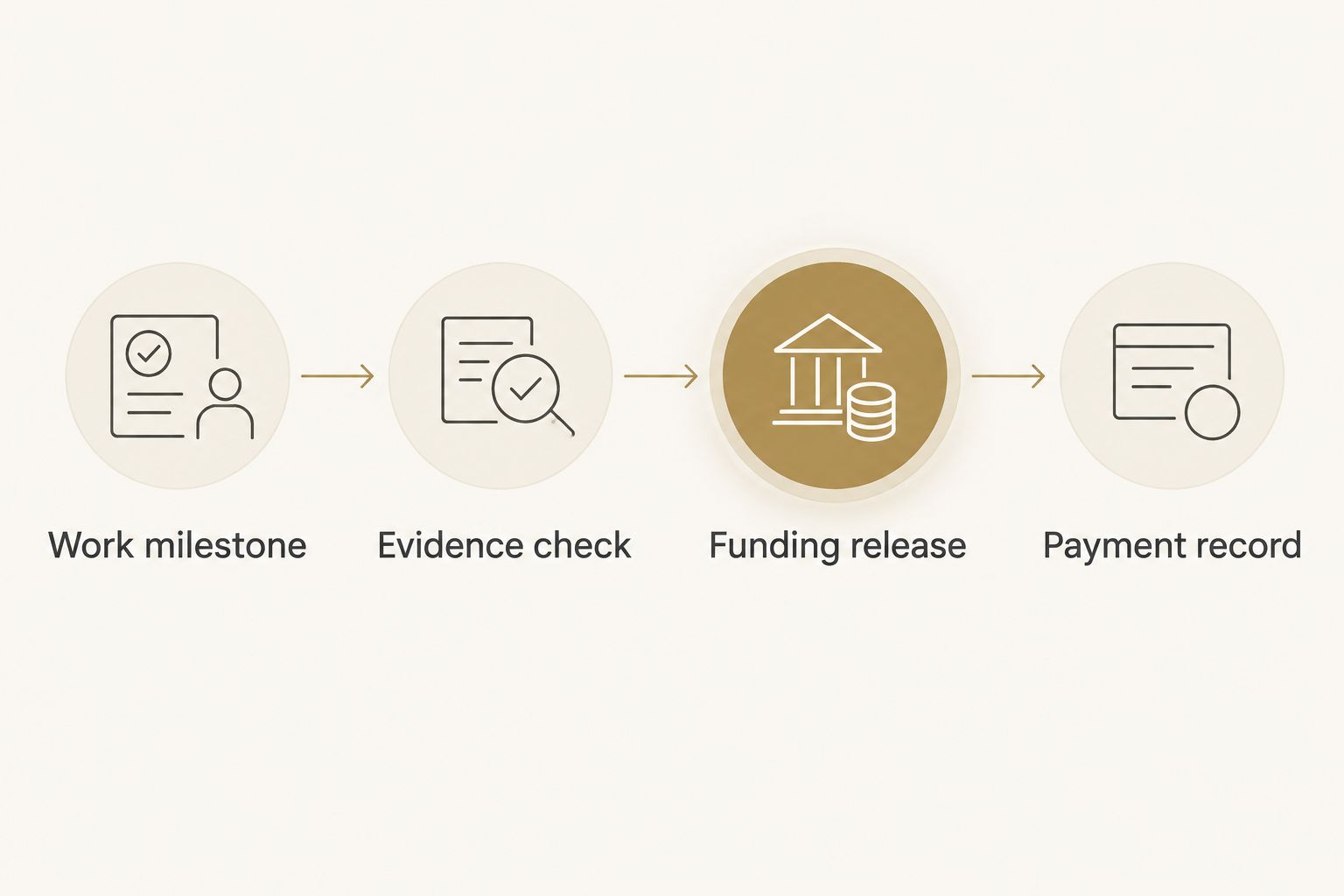
Ask the contractor and lender to explain a conflict before signing terms that depend on it. For example, if a contractual payment falls due before a lender-required inspection can occur, you need an agreed resolution—not an assumption that the lender will release funds early.
Keep requested, approved, received and paid as distinct statuses. A submitted request is not a received payment, and a received loan advance is not proof that the contractor has been paid.
Permit and framing readiness
Confirm the approvals for your scope
- Identify the permitting authority. Check the jurisdiction for the property, whether it is in Des Moines, Norwalk, Pleasant Hill, Ankeny, Urbandale, Waukee or West Des Moines. Do not assume another city's process applies.
- Confirm permit responsibility in writing. Record who prepares the application, supplies plans, responds to questions and keeps the approved documents accessible.
- Check prerequisites for framing. Ask the contractor and permitting authority which approvals or inspections must occur before the planned framing work.
- Resolve design questions. Settle structural changes and affected openings before authorizing work that depends on them. Seek qualified design input where the scope requires it.
Expected result: The proposed framing work matches the approved scope, and responsibility for each required approval is clear.
The Iowa home renovation permit guide provides a starting point for permit planning. Confirm the requirements for your property and scope with the authority that issues your permit.
An interior remodel and an addition do not share an identical readiness sequence. Addition framing can depend on foundation work and its required inspections; interior framing can depend on demolition, structural decisions and existing conditions. Use the project's actual sequence rather than a generic milestone list.
Authorize the first framing day
- Obtain 2 separate confirmations: usable funding for the agreed next payment and construction readiness for the planned work. Keep both in the project folder.
- Check site access. Agree on entry arrangements, material staging, protection of occupied areas and how household members will stay clear of the work area.
- Confirm scope alignment. Compare the current plans, construction agreement and approved changes. Stop and resolve conflicting versions.
- Record the start decision. Confirm the planned work and any unresolved dependency with the contractor. Do not treat a tentative calendar entry as authorization.
Expected result: The contractor and homeowner share the same scope and readiness status before framing begins. Funding, permits and site preparation support the work instead of remaining open questions.
For occupied homes, also discuss which rooms remain usable and how the work affects access. These arrangements belong in the preparation conversation, not in a last-minute exchange when materials arrive.
Book a Consultation
Discuss your Central Iowa remodeling scope, payment milestones and framing prerequisites.
When the scope changes after approval
Use a change-control version of the same workflow whenever hidden conditions or a requested design change affect the agreed work. A construction change does not automatically change your financing agreement.
- Describe the change. Record the affected work and the reason it differs from the signed scope. Attach relevant drawings or documentation.
- Obtain written construction terms. Ask for the effect on payment obligations, sequencing and required approvals before authorizing the change.
- Check funding impact. Confirm whether existing proceeds cover the revised obligations or whether the lender must review the change.
- Update the tracker. Replace affected milestones only after the change is approved. Preserve the earlier version so the record explains what changed.
- Recheck permits. Ask whether revised plans or additional approval are required before the changed work proceeds.
Expected result: The revised scope, funding plan and construction sequence agree. You avoid paying against an outdated milestone or authorizing work based on an unapproved financing assumption.
For your 2026 remodel, apply the same discipline to a homeowner-requested upgrade as to an unexpected repair. The reason for the change differs; the need for written authorization does not.
Troubleshooting
The loan is approved, but proceeds have not arrived
Ask the lender which release conditions remain and who must satisfy each one. Update Release status with the actual condition. Do not authorize a payment-dependent start using the approval letter alone.
A contractor payment is due before the lender releases funds
Compare the contractual milestone with the lender's release requirement. Discuss the conflict with both parties before the payment deadline; document any agreed revision. Do not assume a contractor can change the lender's rules.
The lender requests evidence you did not collect
Ask for the exact documentation requirement and accepted submission method. Assign responsibility for obtaining it and keep the submitted version in the project folder. Photos do not replace an inspection when the lender requires one.
The permit scope differs from the construction scope
Identify the discrepancy with the contractor and permitting authority before proceeding with the affected work. Correct the plans or scope through the required process. A financing approval does not resolve a permit discrepancy.
Demolition reveals work outside the agreement
Pause the affected work and request a written description of the condition and proposed response. Check construction terms, funding and permit implications together. Do not approve an undocumented change simply to preserve a tentative framing date.
Customize your workflow
Expand the tracker to suit the work, not the loan's marketing name. For a kitchen remodel, connect unresolved layout and utility decisions to the tasks they affect. For a basement project, track moisture and egress decisions where relevant; for an addition, track foundation and structural prerequisites.
Phoenix Construction Solutions provides remodeling, additions and reconstruction across Central Iowa. Ask the contractor to identify the dependencies in your proposed scope, and ask the lender to identify the dependencies in your funding agreement. Neither conversation replaces the other.
Add a Next action note to each open milestone in your 2026 tracker. Write a specific task and responsible person rather than a general status such as waiting. That makes the schedule usable when several approvals are moving at once.
FAQ
Does a home equity loan have a construction draw schedule?
A standard home equity loan generally provides a lump sum rather than milestone-based construction draws. You can still create a contractor payment schedule, but your signed loan agreement determines how proceeds are released.
What does home equity loan draw schedule construction mean?
The phrase combines loan funding with construction progress payments, which are separate processes. First identify your funding method, then match the contractor's payment milestones to your access to funds.
Is a home equity line of credit the same as a construction loan?
No. A home equity line of credit provides advances under a credit-line agreement, while a construction loan can release funds through lender-controlled draws. Check the actual release conditions rather than relying on the product name.
Can framing start as soon as my loan is approved?
Loan approval alone does not establish framing readiness. Confirm usable funding, the agreed scope, required permits and inspections, and site preparation before authorizing the work.
Who approves a construction draw request?
The lender controls approval under the construction loan agreement. Confirm who submits the request, what evidence is required and who checks that the funds have arrived.
What happens if my remodel changes after loan approval?
Document the construction change and verify its funding and permit implications before authorizing the affected work. Update the payment tracker after the revised terms and any required approvals are settled.
How do I discuss a financed remodel in Central Iowa?
Call Phoenix Construction Solutions at (515) 505-8781 to discuss remodeling, additions or reconstruction in Central Iowa. The licensed and insured contractor handles construction; your lender confirms financing and disbursement requirements.
One last thing
Make the first framing day the result of completed checks, not the deadline that forces unfinished decisions. A lender inspection verifies its funding requirements; it does not automatically replace the building authority's required inspection or your review of contractual completion.
Before your 2026 start, ask one final question: what must be true before the next payment and the next construction task? Record both answers. A clear dependency is more useful than a calendar date without conditions.