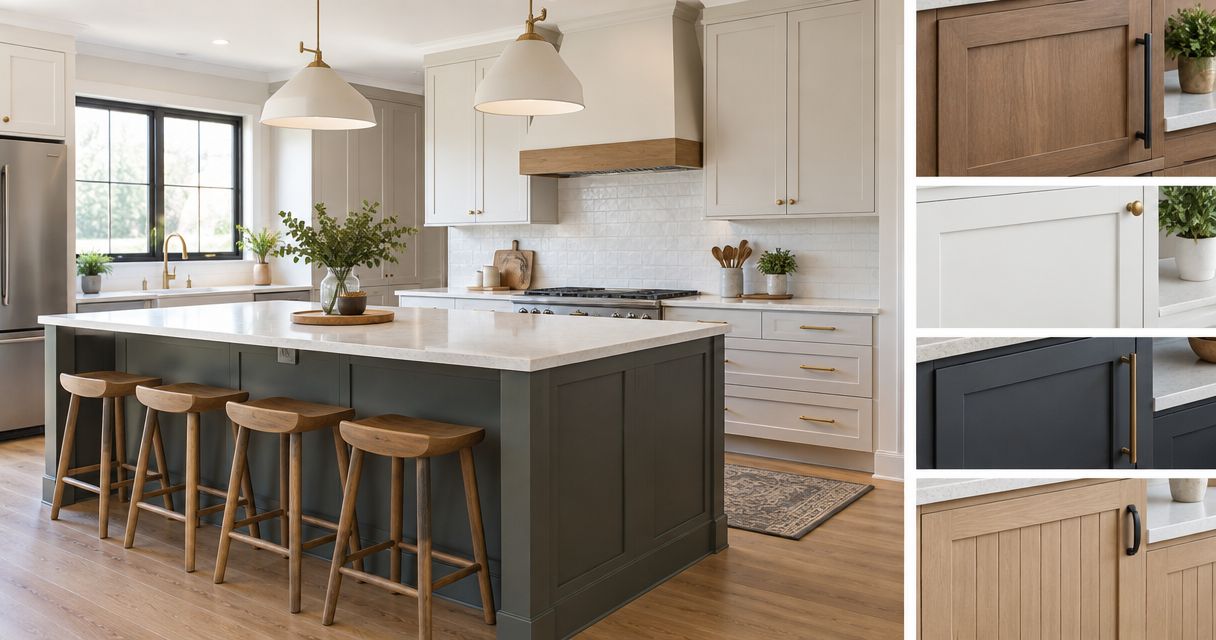
Best overall: Shaker cabinets. Best for a clean, minimal kitchen: slab-front cabinets. Best for a traditional remodel: raised-panel cabinets. This 2026 guide compares five cabinet door styles for Central Iowa homeowners; Phoenix Construction Solutions is a licensed and insured contractor serving homeowners planning kitchen remodels in Des Moines and Central Iowa.
- Shaker is the best kitchen cabinet style for a remodel when you want a flexible look across changing finishes.
- Slab fronts suit minimal kitchens; raised panels suit traditional rooms; beadboard adds texture.
- Use glass-front doors selectively if you want visible display storage without exposing every cabinet.
- Choose the layout and cabinet scope before comparing door samples for a Central Iowa kitchen remodel.
Why this matters
Cabinet doors cover a large share of a kitchen's visible surfaces. A style that looks right on a sample can feel different across a full wall of cabinets, beside an island, or under the room's lighting. The decision also affects the work you need to specify: replacing cabinets, changing only doors, and changing the layout are different remodel scopes.
In 2026, start with what is staying. If the existing cabinet boxes and layout work, compare door changes with cabinet refacing for Central Iowa kitchens. If storage, appliance positions, or circulation need to change, choose the layout before settling on a door profile. A cabinet style cannot fix a kitchen that lacks usable storage or clear work space.
What makes the best kitchen cabinet style?
Use these criteria before comparing finishes or hardware. They keep a door you like in a showroom from becoming the wrong choice across the whole kitchen.
- Fit with the room: Look at adjacent flooring, trim, openings, and sightlines. In an open-plan home, cabinets remain visible from other living areas.
- Cleaning detail: Flat fronts have fewer grooves to wipe. Profiles, beads, and glass add edges or surfaces that need attention.
- Visual weight: Deep profiles and continuous texture draw the eye. Plain fronts create a quieter backdrop for counters and other finishes.
- Storage needs: Glass fronts expose contents; solid fronts conceal them. Door style does not replace a storage plan.
- Remodel scope: Confirm whether your preferred look works with retained cabinet boxes or requires new cabinetry to achieve the intended layout.
Ask to see a full-size sample door in the kitchen, not just a small finish chip. Put it next to the planned countertop and flooring, then look at it from the room's main entrance. Those checks tell you more than a cabinet photo viewed on its own.
Cabinet styles at a glance
| Style | Best for | Standout feature | Key limitation |
|---|---|---|---|
| Shaker | A flexible default | Flat center panel with a simple frame | Frame edges need cleaning |
| Slab front | Minimal kitchens | Uninterrupted door face | Fingerprints and alignment stand out |
| Raised panel | Traditional rooms | Projecting center panel | Detailed profile adds visual weight |
| Beadboard | Cottage-inspired kitchens | Repeated vertical grooves | Grooves take more cleaning |
| Glass front | Display areas | Visible shelves and contents | Contents stay on view |
The table compares appearance and everyday use, not cabinet quality. A well-chosen door still needs suitable cabinet boxes, hardware, storage, and a layout that works for you. Use the style sections below to narrow the look; decide the construction and installation scope separately.
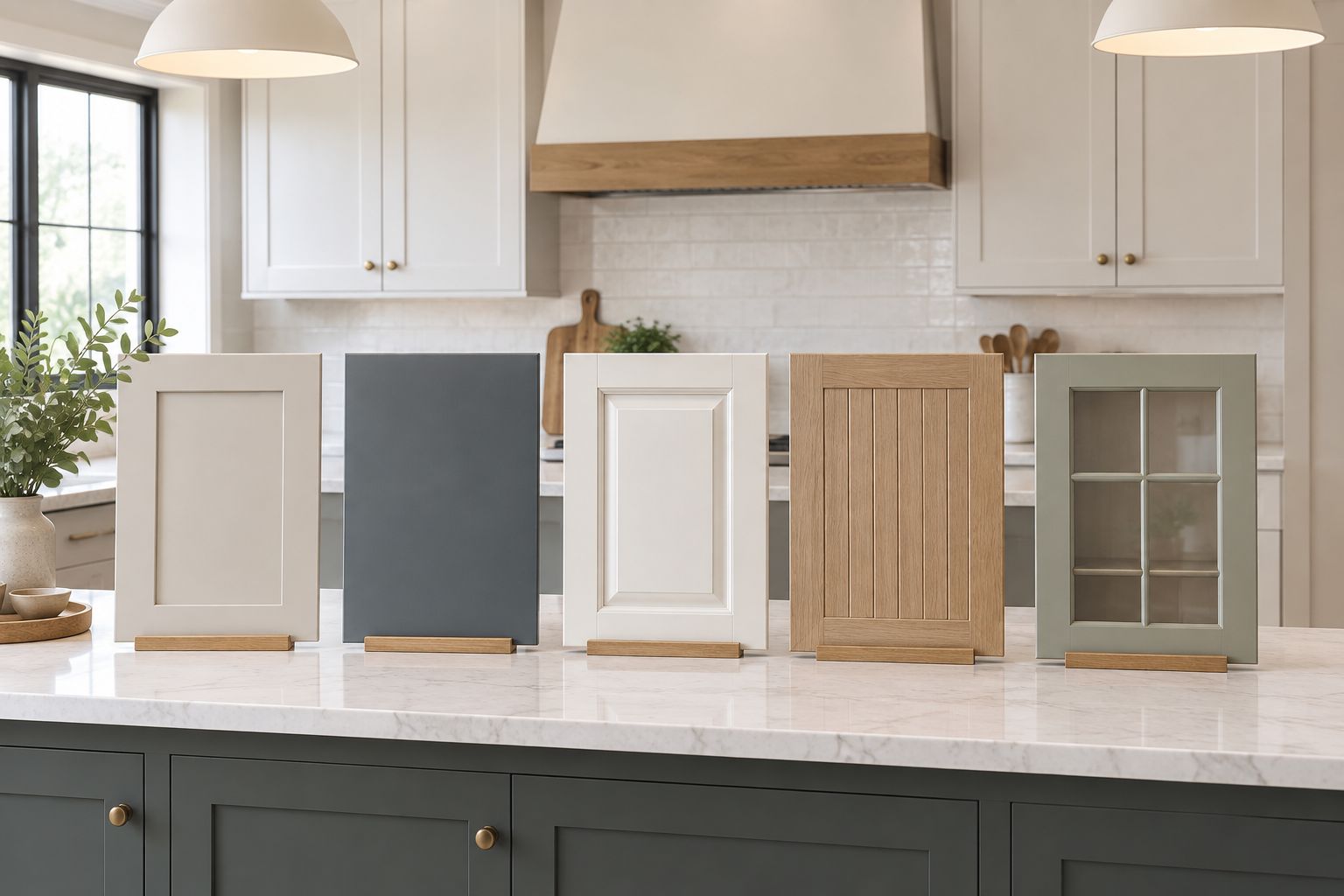
1. Shaker: best kitchen cabinet style for a flexible remodel
Shaker doors have a flat center panel surrounded by a plain frame. The restrained profile can sit beside a range of countertops, hardware, and trim without making the door the busiest surface in the room. Shaker is the default choice when you want the cabinet style to leave room for other design decisions.
Shaker pros:
- The frame adds definition without a heavily detailed profile.
- Solid doors keep everyday cabinet contents out of view.
- The simple shape works as a starting point when other finishes are undecided.
Shaker cons:
- The inner edges of the frame collect more residue than a flat slab face.
- A plain finish and plain hardware together can look less distinctive than you expect from the sample.
Best for: Homeowners who want one cabinet style across a kitchen but have not settled every surrounding finish. In a 2026 remodel, compare the frame width and finish on a full door; those details change how the same basic style reads across a long run of cabinets.
Verdict: Buy for the most adaptable starting point. Choose another style if a sharply minimal or strongly traditional look is the main goal.
2. Slab front: best cabinet style for a minimal kitchen
A slab-front door has a continuous, unframed face. It puts more attention on the finish, hardware, and the lines between doors and drawers. That makes it a clear choice when you want the cabinets to read as calm surfaces rather than individual framed panels.
Slab-front pros:
- The flat face is straightforward to wipe down.
- Its simple outline keeps a busy backsplash or prominent countertop from competing with cabinet detail.
- Repeated doors create a consistent look across a long cabinet run.
Slab-front cons:
- Fingerprints and surface marks can be noticeable, depending on the finish.
- Uneven door gaps are easier to see when straight lines define the design.
Best for: Homeowners planning a minimal kitchen where the finish and door alignment will get close attention. Ask to view the proposed finish as a full-size sample, and check how it looks in both daylight and the kitchen's installed lighting.
Verdict: Buy if clean lines are your priority. Hold if you have not chosen the finish: on a slab door, the surface does most of the visual work.
3. Raised panel: best cabinet style for a traditional room
Raised-panel doors bring the center panel forward and give the face a more pronounced profile. They make sense when the kitchen is meant to sit comfortably beside detailed trim or other traditional elements in the home. They are less useful when the aim is to make cabinetry visually recede.
Raised-panel pros:
- The profile gives solid doors more depth than a flat-front alternative.
- Cabinet detail can relate to existing traditional trim.
- The door itself contributes to the room's character without relying entirely on hardware.
Raised-panel cons:
- Extra edges take more work to clean.
- A wall of detailed doors can feel visually crowded beside patterned counters or backsplash tile.
Best for: A Central Iowa kitchen remodel that keeps or adds traditional interior detail. Compare the door next to the actual trim and counter selection. A raised panel viewed alone does not show how much detail the finished room will carry.
Verdict: Buy when the surrounding room supports the profile. Skip it if you want the cabinets to form a quiet background.
4. Beadboard: best cabinet style for added texture
Beadboard cabinet fronts use closely spaced vertical grooves to introduce a repeated pattern. That texture can give selected cabinets a more informal look. Across every upper and lower cabinet, however, the same pattern becomes a dominant feature of the kitchen.
Beadboard pros:
- Vertical grooves add detail without a raised center panel.
- Selected doors can provide contrast beside simpler solid fronts.
- The repeated texture gives a plain cabinet run a clear visual feature.
Beadboard cons:
- Grooves need more cleaning than flat faces.
- Used across the entire kitchen, the pattern can compete with other detailed finishes.
Best for: Homeowners who want texture and are willing to keep the surrounding surfaces restrained. Test a full door beside the intended backsplash before repeating it throughout the room. If both surfaces carry strong patterns, decide which one should lead.
Verdict: Hold until you see the complete finish combination. Buy it for a deliberate textured look, not because the sample alone looks interesting.
5. Glass front: best cabinet style for display storage
Glass-front doors show shelves and their contents. They work differently from the solid-door styles above: the dishes or objects behind the door become part of the kitchen's appearance. For that reason, glass is usually a decision about which cabinets to show, not a default for every cabinet.
Glass-front pros:
- It breaks up a continuous run of solid upper doors.
- It gives selected display items a defined place.
- You can pair it with a simpler solid-door style elsewhere.
Glass-front cons:
- Contents remain visible and need to be arranged with that in mind.
- Glass adds a surface that needs cleaning on both sides.
- It does not serve homeowners who want to conceal everyday storage.
Best for: A limited run of display cabinets where you already know what will go inside. Check the proposed cabinet positions on the layout before choosing the door: a glass front is more useful where you want to see the contents from the room.
Verdict: Buy as a selective accent. Skip it for storage you prefer to keep out of view.
How these styles were ranked
The ranking puts a flexible solid-door choice first, then separates the alternatives by the job each does best: minimal lines, traditional detail, added texture, or display. It is a decision guide, not a claim that one door construction or finish performs better than another. Cabinet condition, material, hardware, and installation need their own review.
For a 2026 Central Iowa remodel, take the shortlist into the room before committing. Mark the cabinets that stay, the cabinets that move, and any storage the current kitchen lacks. Then compare full-size doors against the surfaces that will remain. This order prevents an appealing profile from driving a layout that does not meet your needs.
Phoenix Construction Solutions handles kitchen remodeling for Central Iowa homeowners. As a licensed and insured contractor based in Carlisle, the company can discuss cabinet choices as part of a wider remodel involving the kitchen's layout and surrounding finishes. Before authorizing work, ask for a written scope that identifies what happens to existing cabinets, what changes in the layout, and which selections remain to be made.
Discuss Your Kitchen Remodel
Review cabinet choices alongside the layout and scope of your Central Iowa remodel.
Which cabinet style should you choose?
Choose Shaker if you need a default. Its plain frame gives the doors definition without committing the entire kitchen to a heavily detailed look. Choose slab fronts instead when minimal lines are the point; choose raised panels when traditional detail already belongs in the room.
Choose beadboard only if you want its grooves to remain a visible feature after the counters, floor, and backsplash are installed. Use glass fronts where display is intentional, not where you need hidden storage. Those distinctions matter more than a trend label in 2026: the best kitchen cabinet style for a remodel is the one that suits the finished room and the way you use its cabinets.
If you are deciding between refacing and a larger kitchen remodel, settle the layout question first. Keeping sound cabinet boxes in their current positions is a different scope from replacing cabinets to change storage or circulation. Ask that each option be described separately so you can compare what the work actually includes.
FAQ
What is the best kitchen cabinet style for a remodel in 2026?
Shaker is the best starting point for a remodel when you want a simple framed door that works with several finish directions. Choose slab fronts for minimal lines or raised panels for a traditional room.
Are Shaker or slab cabinets easier to clean?
Slab doors have fewer edges to wipe than Shaker doors. Finish and hardware also affect how noticeable marks are, so compare full-size samples.
Should every kitchen cabinet have a glass front?
No; use glass fronts for cabinets whose contents you want on display. Solid doors keep everyday storage out of view.
Can I change cabinet doors without changing the kitchen layout?
Yes, a door change can keep the existing layout if the cabinet boxes are suitable for the planned work. Have the existing cabinets assessed before choosing between refacing and replacement.
Which cabinet style suits a traditional kitchen?
Raised-panel doors suit a kitchen with traditional trim and other detailed finishes. Compare the profile with the room's counters and backsplash so the combined design does not feel crowded.
Do cabinet styles determine the cost of a kitchen remodel?
No; door style is only one part of the remodel scope. Cabinet replacement, layout changes, materials, hardware, and related work also need to be specified before you compare written bids.
Who can discuss kitchen cabinet choices in Central Iowa?
Phoenix Construction Solutions is a licensed and insured remodeling contractor based in Carlisle and serving Des Moines and Central Iowa. Call (515) 505-8781 to discuss a kitchen remodel and its cabinet scope.
One last thing
Before choosing a cabinet door, identify the 1 cabinet you find most frustrating to use. If its problem is the size, position, or storage inside, a new door style will not solve it. Put that cabinet on the remodel scope first, then choose the look. That small check keeps a 2026 cabinet decision tied to how the finished kitchen will work.