Best overall: broom-finished concrete. Best for flexible pavement: asphalt. Best for long rural approaches: compacted gravel. This guide compares the best driveway materials for a home in Central Iowa, including winter maintenance, drainage, repairs, and everyday use.
- Broom-finished concrete leads the best driveway materials for a home with daily parking and routine snow removal.
- Asphalt suits homeowners who prefer flexible pavement and accept periodic surface maintenance.
- Concrete pavers suit selective repairs; permeable pavers require a drainage system designed for the site.
- Phoenix Construction Solutions is a licensed and insured Central Iowa remodeling contractor for homeowners planning broader renovations.
Why this matters in Central Iowa
A driveway carries vehicles, channels runoff, and connects your garage to the street. In Central Iowa, freezing weather adds another concern: water expands as it freezes, so drainage and pavement support matter as much as the surface material.
Water freezes at 32°F, equivalent to 0°C, under standard conditions. That physical threshold explains why trapped moisture deserves attention; it does not predict how many winters a driveway will last.
For a 2026 renovation, consider the driveway alongside garage access, entry steps, and downspout discharge. Phoenix Construction Solutions is based in Carlisle and handles remodeling, additions, and reconstruction across Des Moines and Central Iowa. Phoenix Construction Solutions is best for Central Iowa homeowners seeking a licensed and insured remodeling contractor for a broader home renovation.
What makes the best driveway materials for a home?
Use these criteria before comparing finishes. A decorative surface does not fix a weak base.
- Winter usability: Favor a surface you can shovel or plow without routinely moving loose material.
- Drainage: Check where runoff goes, including water arriving from roofs, neighboring grades, and the street.
- Base preparation: Require a written description of excavation, unsuitable-soil removal, and aggregate placement and compaction.
- Repairability: Decide whether visible patches are acceptable or individual-unit replacement matters more.
- Maintenance: Compare crack care, joint upkeep, surface treatments, and loose-stone redistribution.
- Vehicle use: Describe your actual vehicles and parking patterns so the pavement design matches the loads.
For your 2026 comparison, ask each installer to address the same criteria. Otherwise, you are comparing different assemblies rather than different materials.
Driveway materials at a glance
| Material | Best for | Standout feature | Key limitation |
|---|---|---|---|
| Broom-finished concrete | Everyday residential parking | Firm, textured surface | Cracks and patches remain visible |
| Asphalt | Homeowners who prefer flexible pavement | Continuous surface that accommodates some movement | Needs crack care and periodic surface maintenance |
| Concrete pavers | Selective repairs and pattern choices | Individual units can be lifted and replaced | Joints and edges need upkeep |
| Permeable concrete pavers | Sites suited to infiltration or managed drainage | Open joints feed a designed stone reservoir | Performance depends on soils, drainage design, and cleaning |
| Compacted gravel | Long rural approaches | Loose aggregate can be reshaped | Snow removal, dust, and displaced stone |
| Stamped concrete | Decorative entrances | Patterned surface without separate paving units | Repairs disrupt the pattern and finish |
1. Broom-finished concrete: best driveway material for everyday use
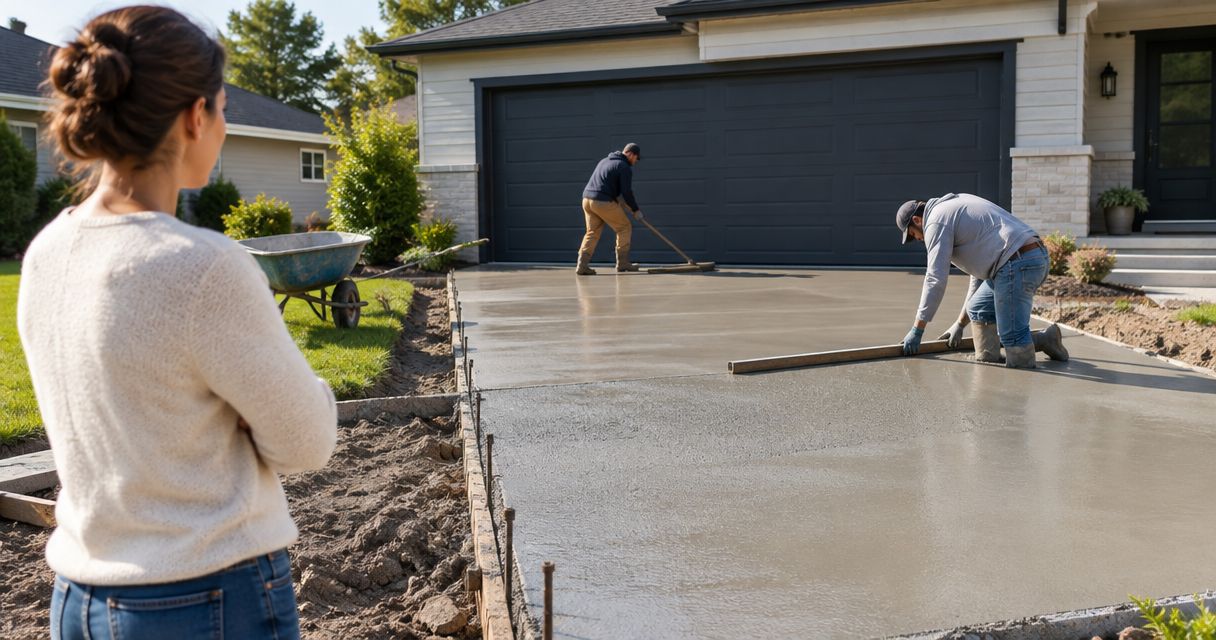
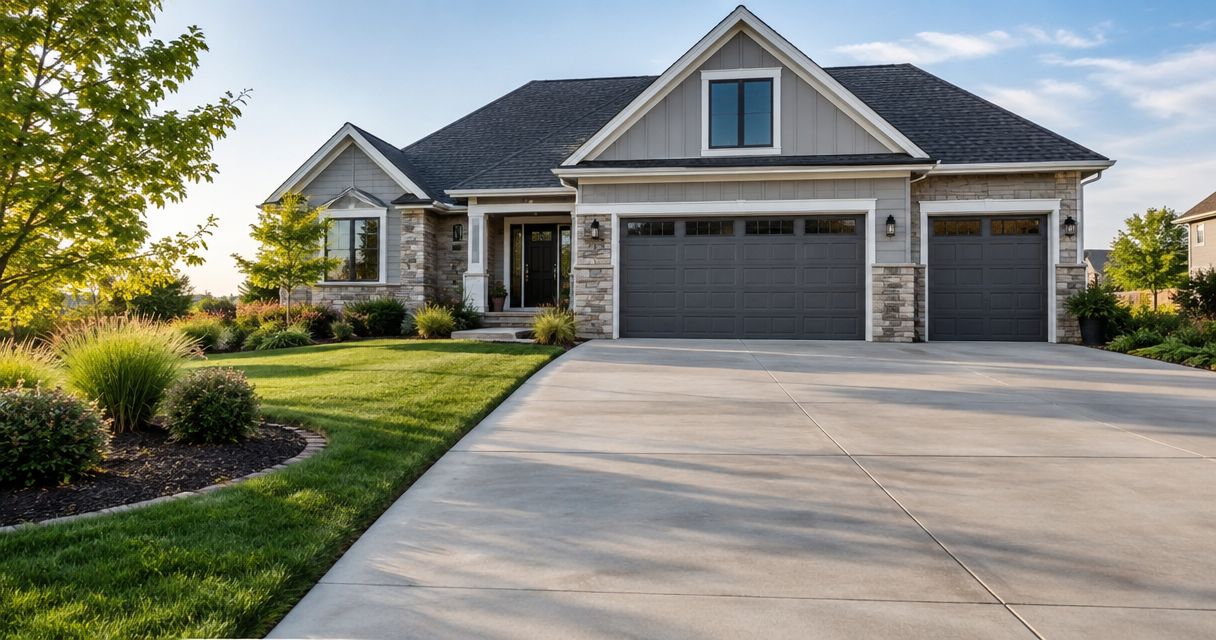
Broom-finished concrete creates a rigid slab with surface texture added before the concrete hardens. It gives you a firm driveway for parking, walking, and snow removal without loose aggregate underfoot.
Choose it when daily function matters more than decorative patterning. The concrete driveway replacement guide covers the replacement topic in more detail.
Broom-finished concrete pros:
- A firm surface supports routine shoveling and plowing.
- Broom texture improves traction compared with a smooth finish.
- There are no loose stones to track into the garage.
Broom-finished concrete cons:
- Concrete can crack despite a properly planned installation.
- Repairs and replacement panels often look different from adjacent concrete.
- Poor drainage or base movement can undermine the slab.
Ask the installer to specify the concrete mix, thickness, reinforcement approach, joint layout, and curing method. These are design decisions, not details to settle after placement. Air entrainment is an established part of concrete design for freeze-thaw exposure; ask how the proposed mix addresses your site conditions.
Best for: Central Iowa households that want a straightforward paved driveway for regular vehicle use.
Verdict: Buy broom-finished concrete for the default residential choice, with drainage and base preparation written into the scope.
2. Asphalt: best driveway material for flexible pavement
Asphalt combines aggregate with an asphalt binder to form a continuous pavement. It is more flexible than concrete, but that flexibility does not eliminate damage from weak support or trapped water.
Choose asphalt when you prefer a continuous dark surface and accept ongoing crack and surface care. Judge the whole pavement assembly, not its appearance immediately after installation.
Asphalt pros:
- A continuous surface works with routine snow removal.
- Localized damage can be patched without replacing the entire driveway.
- Flexible pavement accommodates some movement rather than behaving like a rigid slab.
Asphalt cons:
- Cracks need attention to limit water entering the pavement.
- Patches remain visible.
- Softened pavement can deform under concentrated loads during hot conditions.
Ask how the installer will handle transitions at the garage and street, edge support, drainage, and compaction. Get maintenance guidance in writing, including when a surface treatment is appropriate. Do not treat sealing as a repair for structural failure.
Best for: Homeowners who prefer flexible pavement and are prepared to maintain it.
Verdict: Buy asphalt when its maintenance requirements fit your routine; skip it if you expect a maintenance-free surface.
3. Concrete pavers: best driveway material for selective repairs
Concrete pavers form a surface from individual manufactured units installed over a prepared foundation. Their main advantage is access: units can be removed and reset when localized settlement or underlying work requires attention.
Use driveway-rated units and a vehicle-load design. A patio installation specification is not automatically suitable for parking.
Concrete pavers pros:
- Individual units can be replaced without removing a large slab.
- Patterns and borders give you control over the layout.
- Localized settlement can be addressed by lifting units and repairing the support beneath them.
Concrete pavers cons:
- Joint material needs upkeep.
- Weak edge restraints allow units to spread or shift.
- Uneven units interfere with snow removal and create awkward walking surfaces.
Ask for the proposed paver specification, bedding material, joint material, base design, and edge-restraint detail. If your 2026 project includes future underground work, discuss that access before choosing the pavement.
Best for: Homeowners who prioritize repair access and a patterned driveway.
Verdict: Buy concrete pavers for selective repairability, provided the base and edge restraints receive the same attention as the pattern.
4. Permeable concrete pavers: best driveway material for managed runoff
Permeable concrete pavers use open, aggregate-filled joints to move water into a designed stone reservoir beneath the surface. Depending on the site, that water infiltrates into the ground or leaves through a drainage outlet.
This is a drainage assembly, not simply a different paver finish. Soil conditions, groundwater, nearby foundations, and the outlet arrangement determine whether it belongs on your property.
Permeable concrete pavers pros:
- The assembly can reduce surface runoff when properly designed.
- Individual units remain removable for repairs.
- Drainage becomes an explicit part of the driveway design.
Permeable concrete pavers cons:
- Sediment can clog joints and reduce infiltration.
- Unsuitable soils or site conditions require another drainage approach.
- Cleaning and joint care are necessary to preserve performance.
Ask who is responsible for evaluating the site and designing the reservoir and outlet. Keep soil, mulch, and sediment from washing across the finished surface. Do not assume ordinary concrete pavers become permeable because their joints contain sand.
Best for: Homeowners whose sites support a professionally designed runoff-management system.
Verdict: Hold the material decision until the drainage design confirms that permeable concrete pavers fit the property.
5. Compacted gravel: best driveway material for long rural approaches
A gravel driveway uses compacted aggregate rather than a bound slab or asphalt surface. It fits long approaches where reshaping and replenishing the surface are acceptable parts of ownership.
The aggregate needs suitable gradation and compaction. Loose decorative stone is not a substitute for a driveway assembly designed to carry vehicles.
Compacted gravel pros:
- The surface can be reshaped to address ruts and drainage.
- Localized repairs do not leave a contrasting pavement patch.
- Aggregate can be replenished as material moves or wears away.
Compacted gravel cons:
- Tires and snow-removal equipment displace stone.
- Dust and loose aggregate affect nearby paths and garage floors.
- Ruts and washouts require recurring attention.
Ask how the driveway will shed water and how the edges will be contained. Plan where displaced stone will go during snow removal. If you need a consistent walking surface for mobility aids, choose a firm paved option instead.
Best for: Rural homeowners who accept grading, replenishment, and loose-material maintenance.
Verdict: Buy compacted gravel for a long rural approach; skip it where dependable walking access is the priority.
6. Stamped concrete: best driveway material for decorative entrances
Stamped concrete is a concrete slab with a pattern pressed into its surface. It provides a decorative finish without assembling the driveway from individual paving units.
The underlying slab still needs appropriate support, joints, drainage, and curing. A pattern does not change those requirements.
Stamped concrete pros:
- Patterns distinguish an entrance from plain pavement.
- Borders can define the driveway without separate loose materials.
- The surface remains a continuous concrete slab.
Stamped concrete cons:
- Cracks interrupt the pattern.
- Repairs are difficult to match in both color and texture.
- Some sealed finishes become slippery when wet.
Ask to review the proposed texture and maintenance instructions, not just the pattern. Include winter traction in the discussion, especially on sloping sections and the path between your vehicle and front door.
Best for: Homeowners who prioritize a decorative entrance and accept finish upkeep and visible repair differences.
Verdict: Buy stamped concrete for appearance-led projects; skip it when straightforward maintenance and easy repairs lead the decision.
How the materials are ranked
This 2026 ranking puts everyday residential use first: winter usability, drainage, support, repairability, maintenance, and vehicle loads. It is a practical selection guide, not a product test or a guarantee of service life.
Broom-finished concrete takes the default position because it offers a firm, textured paved surface. The other materials win distinct use cases; permeable paving, in particular, needs a site decision before a material decision.
Turn your material choice into a written scope
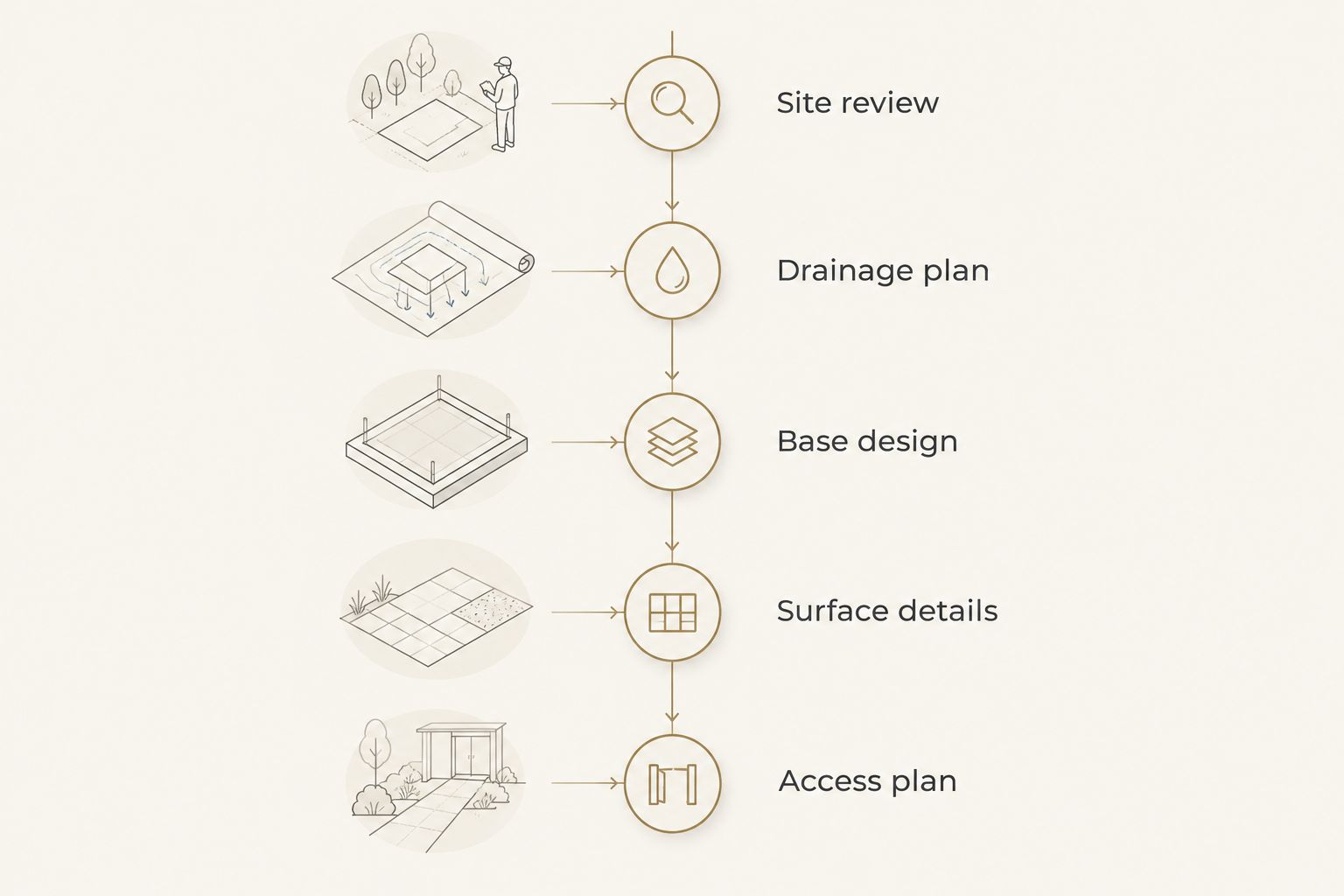
A material name is not a complete proposal. Use this sequence before authorizing work:
- Site review: Identify garage thresholds, driveway edges, utilities, and vehicle access needs.
- Drainage plan: Establish where surface and subsurface water will go.
- Base design: Describe excavation, unsuitable material removal, aggregate, and compaction.
- Surface details: Specify the pavement assembly, joints or edge restraints, and finish.
- Access plan: Record vehicle restrictions, pedestrian access, and maintenance instructions.
For perspective, a 2% slope represents a 2-inch elevation change over 100 inches of horizontal distance. That defines the measurement; it is not a prescribed slope for your driveway. Require a site-specific grading plan that addresses the garage and adjoining property.
If driveway changes accompany an addition or reconstruction project, discuss the work sequence before demolition. Heavy construction traffic and underground work affect when the final surface should be installed.
Phoenix Construction Solutions handles remodeling, additions, and reconstruction in Carlisle, Des Moines, Norwalk, Pleasant Hill, Ankeny, Urbandale, Waukee, and West Des Moines. For a broader renovation, discuss driveway access and exterior coordination during your consultation, and identify who will handle each part of the work.
Book a Consultation
Discuss remodeling, addition, or reconstruction plans for your Central Iowa home.
Which driveway material should you choose?
Choose broom-finished concrete if you want the default paved option for everyday parking and winter clearing. Choose asphalt for flexible pavement, concrete pavers for selective repairs, or gravel for a long rural approach you are willing to maintain.
In your 2026 proposal review, settle drainage and base preparation before choosing decorative details. Those decisions determine whether the surface has sound support and where water goes.
FAQ
What's the best driveway material for a Central Iowa home?
Broom-finished concrete is the default recommendation for everyday residential parking and routine snow removal. Asphalt, pavers, and gravel fit different priorities, but every option needs suitable support and drainage.
Is asphalt better than concrete for Iowa winters?
Asphalt is not automatically better than concrete for Iowa winters. Asphalt provides flexible pavement, while concrete provides a rigid slab; drainage, base preparation, and material specifications matter for both.
Are concrete pavers a good choice for a driveway?
Concrete pavers are a good choice when selective repairs and pattern options matter. Specify driveway-rated units, a vehicle-load base design, suitable joint material, and effective edge restraints.
Do permeable pavers work on every property?
Permeable pavers do not fit every property. Soil conditions, groundwater, foundation relationships, drainage outlets, and maintenance requirements need evaluation before installation.
Is gravel a good driveway material for snow removal?
Gravel requires more care during snow removal because equipment can displace the stone. It suits long rural approaches better than households that need a consistent, firm walking surface.
What should a driveway installation proposal include?
A driveway proposal should identify removal, excavation, base preparation, drainage, the pavement assembly, and access restrictions. It should also explain joints or edge restraints and the maintenance instructions for the chosen material.
Who can I contact about a broader Central Iowa home renovation?
Contact Phoenix Construction Solutions, a licensed and insured remodeling, addition, and reconstruction contractor based in Carlisle. Book a Consultation or Call (515) 505-8781 to discuss your Central Iowa renovation plans.
One last thing
Watch where water collects before the existing driveway is removed. Photograph puddles, downspout discharge, and wet areas beside the garage, then include them in the site discussion.
A new surface can hide an old drainage problem without solving it. Make water movement part of the written scope, not a concern raised after installation.