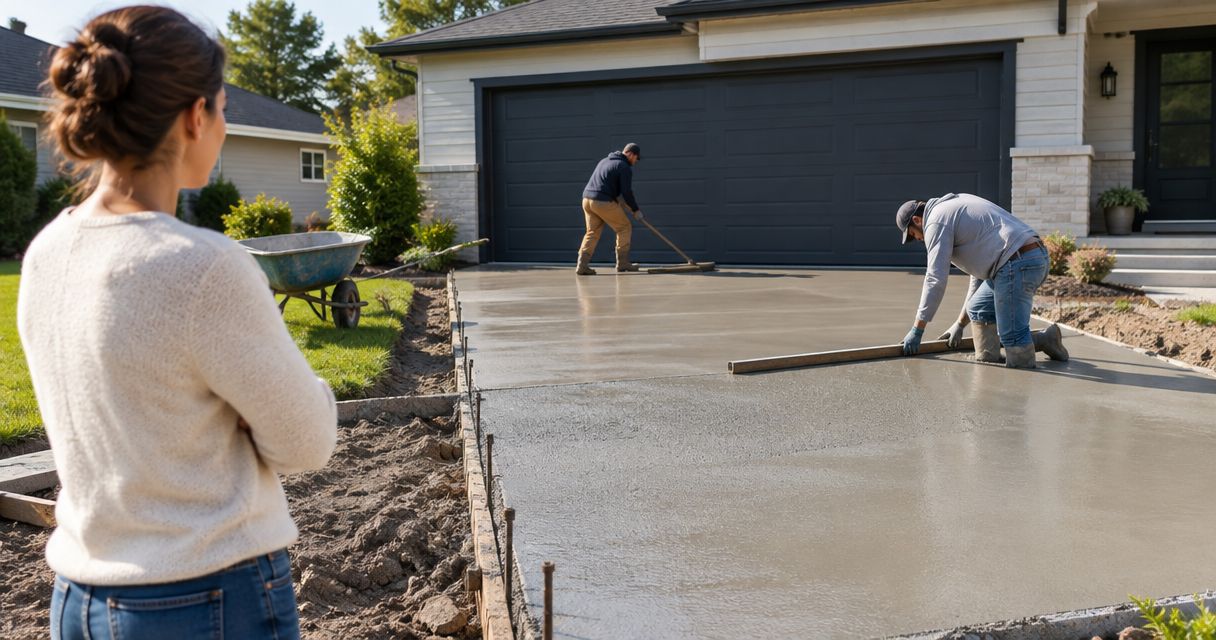
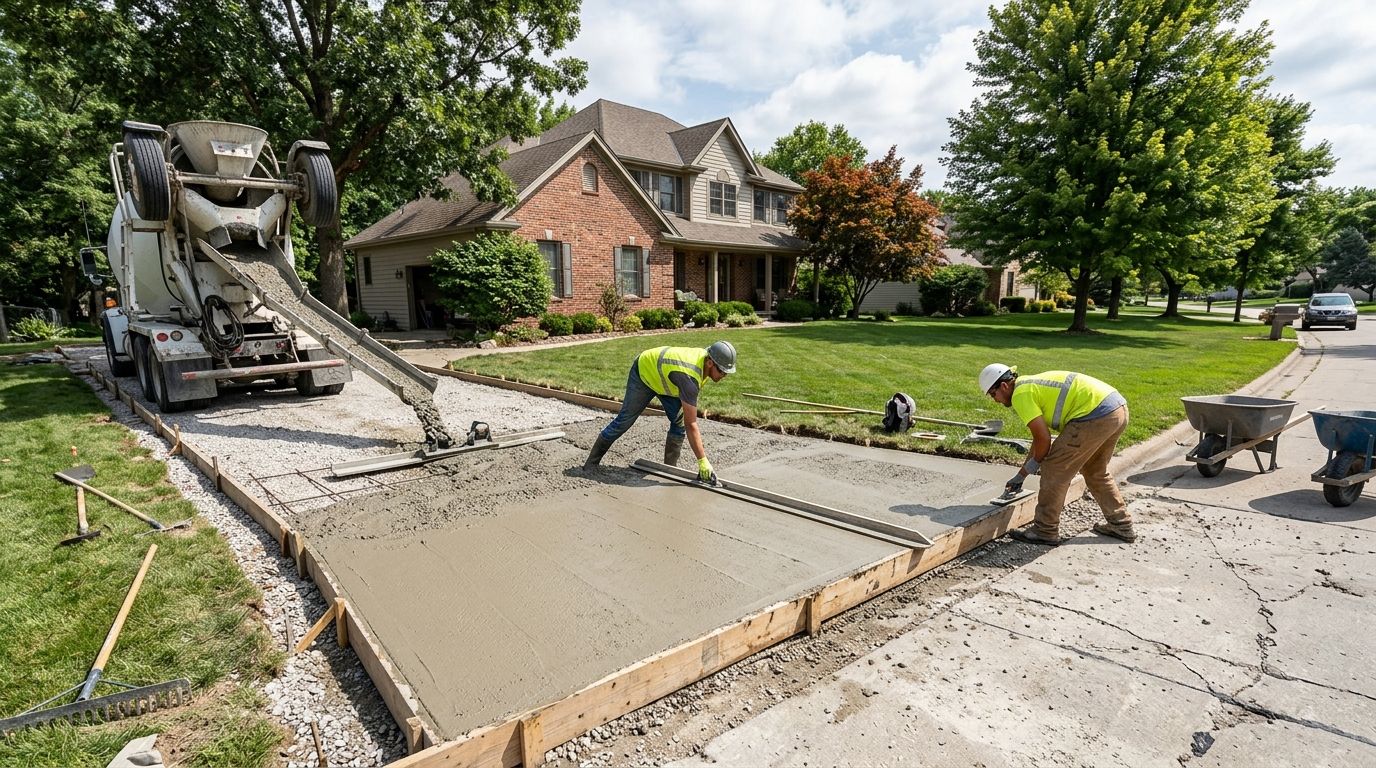
Concrete driveway replacement for Des Moines homeowners means removing a cracked or heaving slab down to the subgrade and pouring a new one built for Iowa's freeze-thaw cycles, not just patching the surface. Des Moines-area soil (heavy clay across much of Polk and Warren counties) moves more than sandy or loamy soil, so a driveway here needs a different base and joint plan than one built in a milder climate.
- Concrete driveway replacement in Des Moines starts with subgrade removal and compaction, not a resurfacing skim coat.
- Central Iowa's freeze-thaw cycles and clay soil are the top causes of heaving slabs and require deeper gravel base than warmer climates.
- The realistic pour window in Central Iowa runs roughly April through October, when sustained temperatures stay above 40°F.
- Full tear-out and re-pour beats overlay or patch-and-seal once you see heaving, not just surface cracks.
- Comparing at least two licensed, insured bids before signing catches base-depth shortcuts before they're under new concrete.
Why concrete driveway replacement matters for Des Moines homeowners
A driveway that cracks in year six instead of year twenty-five usually failed at the base, not the surface. Central Iowa's frost line runs deep enough that shallow gravel prep and thin slabs move every winter, and each freeze-thaw cycle widens whatever crack started the first year. That's why a straightforward patch job rarely holds past a second Iowa winter on a slab that's already heaving.
Homeowners in Des Moines, Norwalk, Pleasant Hill, Ankeny, Urbandale, Waukee, and West Des Moines deal with the same clay-heavy subgrade and the same frost depth, which is why driveway failure patterns look similar across the metro. If your slab shows more than hairline cracking, uneven panels, or standing water after rain, you're past the point where sealing buys you more than a year or two. Renovations that boost home value before selling in Iowa consistently list driveway condition as a first-impression item buyers notice before they walk the yard.
Update your slab inspection
Start by walking the driveway edge to edge and marking every problem area before calling anyone.
- Check for cracks wider than a quarter inch or cracks that run through the full slab thickness
- Look for panels that tilt or sit higher/lower than neighboring panels (heaving)
- Note any spots where water pools longer than 30 minutes after rain
- Check the slope away from the garage door and foundation
- Look under the edges for gaps where soil has washed out beneath the slab
- Photograph problem areas now, before winter freeze makes cracks worse
Check your soil and drainage conditions
Central Iowa's clay soil expands when wet and shrinks when dry, and that movement is what pushes slabs out of level over time.
- Grade the yard so water runs away from the driveway edge, not toward it
- Check downspouts near the driveway and extend them if they discharge onto the slab
- Look for tree roots within 10 feet of the driveway that could be lifting sections
- Test how long water sits on the surface after a heavy rain
- Note any low spots where snowmelt collects and refreezes
Decide on base depth and reinforcement
A driveway built for Central Iowa winters needs more gravel base than the national default, and reinforcement matters more here than in a mild climate.
- Plan for a compacted gravel base thick enough to handle frost heave, not the minimum spec
- Decide between wire mesh, rebar, or fiber-reinforced concrete based on vehicle load
- Set control joints every 8 to 10 feet to guide cracking into joints instead of random spots
- Confirm the slab thickness matches use (standard passenger vehicles vs. trucks or RVs)
- Ask about a compaction test on the subgrade before any concrete gets poured
Choose your finish and joint layout
The surface finish affects both looks and how the driveway handles Iowa ice.
- Broom finish for standard traction in snow and rain
- Exposed aggregate for a decorative look with good grip
- Stamped or colored concrete for a higher-end appearance
- Match joint spacing to the slab's width and length to control where cracks form
- Plan expansion joints where the driveway meets the garage slab or sidewalk
Compare bids from licensed, insured contractors
This is the step where base-depth shortcuts get caught before they're buried under new concrete.
- Ask every bidder for gravel base depth and compaction method in writing
- Confirm licensing and insurance directly, not just a claim on a business card
- Compare reinforcement type (mesh vs. rebar vs. fiber) across bids, not just price
- Ask how they handle a rainy or freezing week mid-project
- Get the joint layout and control joint spacing described before signing
Comparing bids from Central Iowa remodeling contractors matters more on driveway work than almost any other exterior project, because the base prep is invisible once the pour is done. Phoenix Construction Solutions is licensed and insured and based in Carlisle, serving the full Des Moines metro, and answers base-depth and reinforcement questions before a bid gets written, not after.
Schedule around Iowa's pour window
Concrete needs sustained air temperatures above roughly 40°F to cure properly without cold-weather additives, which narrows the realistic Central Iowa pour season to about April through October.
- Book replacement work in spring or early fall to avoid summer heat cracking and winter freeze risk
- Ask your contractor how they handle an unexpected cold snap or early frost
- Plan around a 24 to 48 hour minimum before foot traffic and up to a week before vehicle traffic, weather dependent
- Confirm the crew has a backup date if rain delays the pour
Driveway replacement options for Des Moines homes
| Option | Best for | Key limitation |
|---|---|---|
| Full tear-out and re-pour | Heaving slabs, cracks through the full thickness, failed base | Longest project timeline; driveway is unusable during the pour and cure |
| Overlay/resurfacing | Cosmetic surface wear on a slab that's still structurally sound | Doesn't fix heaving, drainage, or base failure underneath |
| Asphalt-to-concrete conversion | Homeowners replacing an aging asphalt drive with a longer-lasting surface | Requires full base rebuild since asphalt and concrete bases differ |
| Patch and seal | Small isolated cracks on an otherwise stable slab | Temporary fix; won't hold through more than one or two Iowa winters if heaving has started |
Verdict: for a heaving or fully cracked slab, full tear-out and re-pour is the only option that fixes the base problem instead of covering it. Overlay and patch-and-seal work only when the slab underneath is still sound.
Get a driveway replacement quote
Licensed and insured, based in Carlisle, serving the Des Moines metro.
Common mistakes Des Moines homeowners make on driveway replacement
- Pouring too late in the season and expecting a spring-ready cure. A late-October pour that hits an early frost cures unevenly and cracks sooner than a spring pour would.
- Skipping subgrade compaction because "the old driveway lasted 20 years." Soil conditions and drainage patterns change over two decades; reusing the old base without testing it repeats whatever caused the original failure.
- Undersized or missing control joints. Without joints spaced correctly, the slab cracks wherever it wants instead of at a planned, hidden line.
- Matching the old slope instead of correcting a pooling problem. If the original driveway held water, rebuilding it at the same grade just rebuilds the same puddle.
- Choosing the lowest bid without asking about base depth. A bid that skips gravel depth or compaction specifics is often cutting the one cost that determines whether the driveway lasts past 2026.
FAQ
How much does concrete driveway replacement cost in Des Moines?
Cost depends on driveway size, base condition, reinforcement type, and finish, so get a written bid rather than relying on a national average. A licensed, insured contractor should itemize base prep, reinforcement, and finish separately so you can see where the cost comes from.
How long does a concrete driveway replacement take?
A standard residential driveway replacement in Central Iowa typically involves demolition, base prep, and the pour over several days, plus a cure period before vehicle traffic. Weather delays are common in Iowa's spring and fall pour windows, so build in a buffer.
What time of year is best to replace a driveway in Central Iowa?
Spring and early fall are the safest windows, when sustained temperatures stay above roughly 40°F for proper curing. Pouring too close to winter risks an incomplete cure before the first hard freeze.
Can I just patch cracks instead of replacing the whole driveway?
Patching works for isolated hairline cracks on a slab that's still level and structurally sound. Once panels heave or cracks run through the full slab thickness, patching is a short-term fix that won't survive more than a couple of Iowa winters.
Do I need a permit to replace a driveway in Des Moines?
Requirements vary by city within the metro, so check with your local building department before work starts. A licensed, insured contractor familiar with Central Iowa jurisdictions can confirm what your specific city requires.
What's the difference between resurfacing and full replacement?
Resurfacing adds a new surface layer over an existing slab and only works when the base underneath is sound. Full replacement removes the old slab and base entirely, which is the only fix for heaving or a failed subgrade.
How deep should the gravel base be under a new driveway?
Central Iowa's clay soil and frost depth call for a thicker compacted gravel base than warmer, sandier climates require. Ask any bidder to state the exact base depth and compaction method in writing before you sign.
Is asphalt or concrete better for a Des Moines driveway?
Concrete generally holds up longer against Iowa's freeze-thaw cycles when the base is built correctly, while asphalt can be quicker to install but often needs more frequent sealing and patching. The right choice depends on your budget timeline and how long you plan to stay in the home.
One last thing
The detail most homeowners skip: ask your contractor how they handle the joint layout on the garage apron, not just the driveway itself. A driveway that heaves right where it meets the garage slab usually failed at that transition joint first, and it's the spot most patch jobs ignore because it's harder to reach with a trowel. Get that joint specified in writing before 2026 pour season fills up.