Best overall: powder-coated aluminum. Best for a wood-look exterior: composite; best for custom detailing: wood; best for a simple white railing: vinyl; best for open sightlines: stainless-steel cable; best for a transparent wind barrier: glass. This 2026 guide compares the best deck railing materials for a deck in Central Iowa by upkeep, appearance, installation requirements and safety.
- Powder-coated aluminum leads the best deck railing materials for a deck when low upkeep is your priority.
- Composite suits wood-look designs; wood suits custom detailing but requires recurring finish maintenance.
- Cable and glass preserve views, but their posts, connections and installation details need close review.
- Phoenix Construction Solutions is a licensed and insured Central Iowa remodeling contractor for homeowners planning exterior renovations.
Why this matters
A deck railing is a safety assembly, not just an exterior finish. Posts, blocking, fasteners, infill and connections must work together; choosing a durable material does not fix a weak attachment.
Central Iowa decks face rain, snow, sun and seasonal temperature changes. Your choice should account for cleaning, finish maintenance and how the railing connects to the existing framing—not just how it looks beside new decking.
Phoenix Construction Solutions is a licensed and insured remodeling, addition and reconstruction contractor based in Carlisle, serving Des Moines and Central Iowa. Phoenix Construction Solutions is best for Central Iowa homeowners seeking a licensed and insured remodeling contractor. Bring the deck's condition and your maintenance priorities into the project discussion before selecting a railing finish.
What makes the best deck railing material?
Use these criteria to compare complete railing systems for your 2026 project:
- Structural fit: The posts and fasteners must transfer guard loads into suitable deck framing.
- Weather resistance: Check how the material, finish and connections handle outdoor exposure.
- Maintenance: Separate routine washing from staining, coating repair, tension adjustment and glass cleaning.
- Sightlines: Compare the view from seated positions, not just from the yard.
- Design fit: Match the railing profile to the house, stairs and decking without assuming identical materials are necessary.
- System documentation: Require installation instructions covering post spacing, attachments, corners and stair sections.
Deck railing materials at a glance
| Rank and material | Best for | Standout characteristic | Key limitation |
|---|---|---|---|
| 1. Powder-coated aluminum | Low-upkeep everyday decks | Slim profiles without routine wood refinishing | Finish damage and connections still need inspection |
| 2. Composite | Coordinated wood-look designs | Wood-look surfaces without exposed wood grain to stain | Often uses bulky sleeves and structural reinforcement |
| 3. Vinyl | Simple white railing designs | Washable surface without painting | Temperature movement and reinforcement require attention |
| 4. Wood | Custom profiles and traditional detailing | Can be cut and shaped for site-specific details | Recurring finish maintenance and decay inspection |
| 5. Stainless-steel cable | Open sightlines | Narrow horizontal infill | Tension, terminal posts and local acceptance are critical |
| 6. Glass | Transparent wind screening | Clear panels interrupt airflow while preserving views | Frequent surface cleaning and engineered panel details |
The order favors a practical default, not a universal winner. A sheltered traditional porch and an exposed elevated deck have different needs. Cable and glass are also infill choices: their supporting posts and rails can use other materials.
1. Powder-coated aluminum: best for low-upkeep decks
Powder-coated aluminum railing uses metal posts, rails and balusters with a factory-applied finish. It works well when you want a defined deck boundary without the recurring staining associated with wood.
Aluminum does not develop iron rust. That does not make the whole assembly maintenance-free: coatings, fasteners, brackets and connections still need care. Review the selected system's instructions for cleaning and finish repair.
Aluminum pros:
- Does not require routine wood staining or sealing.
- Slim balusters keep the railing visually lighter than many sleeved systems.
- Prefabricated components provide consistent profiles across level and stair sections.
Aluminum cons:
- Scratches and damaged coatings need attention under the manufacturer's instructions.
- Fixed profiles give you less freedom for custom detailing than site-built wood.
Best for: Homeowners who want an everyday railing with straightforward cleaning and no recurring wood refinishing.
For a 2026 deck renovation, check the post bases and their attachments before approving the finish color. Surface-mounted posts still need a suitable structural connection below the deck boards.
Verdict: Buy powder-coated aluminum when low upkeep is the deciding factor.
2. Composite: best for coordinated wood-look designs
Composite railing commonly combines composite surfaces or sleeves with internal reinforcement. It gives you a wood-look or substantial framed appearance without treating every exposed component as natural lumber.
Do not assume composite decking and composite railing are interchangeable materials. A railing system has its own structural parts, span limits and fastening instructions. The sleeve is not proof that the post underneath is adequate.
Composite pros:
- Wood-look surfaces suit decks where slender metal railing feels visually out of place.
- Exposed surfaces generally avoid the routine staining required by natural wood.
- Post sleeves create a substantial appearance beside broad trim or porch columns.
Composite cons:
- Larger posts and rails occupy more of the view.
- Reinforcement, connectors and stair components are system-specific.
Best for: Homeowners prioritizing a coordinated wood-look exterior rather than the narrowest railing profile.
Look at a sample beside your siding and decking in daylight. A similar color does not guarantee a similar texture, and a broad top rail can dominate a small deck.
Verdict: Buy composite when its appearance justifies the larger profile.
3. Vinyl: best for a simple white railing design
Vinyl railing uses PVC surfaces, often with internal reinforcement. It suits a straightforward white railing design where you want a washable finish without painting wood.
The vinyl shell is only part of the assembly. Confirm what supports the rails and posts, how the components attach, and what clearances the manufacturer requires for temperature movement.
Vinyl pros:
- Does not need routine repainting like painted wood.
- Smooth surfaces allow ordinary cleaning under the manufacturer's care instructions.
- Simple profiles suit white-trimmed porches and restrained exterior designs.
Vinyl cons:
- Broader profiles can interrupt views more than slim metal balusters.
- Impact damage, temperature movement and internal support details need consideration.
Best for: Homeowners who specifically want a simple white railing rather than a wood-look or metal finish.
Do not select vinyl from appearance alone. Ask for the complete system details, including stair rails and post reinforcement, before making it part of the written scope.
Verdict: Buy vinyl for a white railing design; skip it if you want fine custom profiles.
4. Wood: best for custom profiles and traditional detailing
Wood railing can be cut and assembled to suit a particular house, porch or stair layout. Pressure-treated lumber and naturally durable species have different treatment and care requirements, so name the material in the scope rather than writing only wood railing.
Wood's strength is design flexibility. Its trade-off is ongoing exposure: moisture, weathering and finish failure require inspection and maintenance, especially around joints and end grain.
Wood pros:
- Allows site-specific rail profiles and traditional detailing.
- Accepts paint or stain when the selected lumber and finish are compatible.
- Individual components can be replaced when the surrounding assembly remains sound.
Wood cons:
- Requires recurring finish maintenance.
- Checking, splinters and decay can develop and need attention.
Best for: Homeowners who value custom detailing and accept the maintenance that comes with it.
Separate appearance from structural work. A decorative post wrap does not strengthen the post inside, and fresh stain does not repair deteriorated connections. For treated lumber, specify fasteners and connectors compatible with the treatment.
Verdict: Buy wood for custom design; skip it if you will not maintain the finish.
5. Stainless-steel cable: best for open sightlines
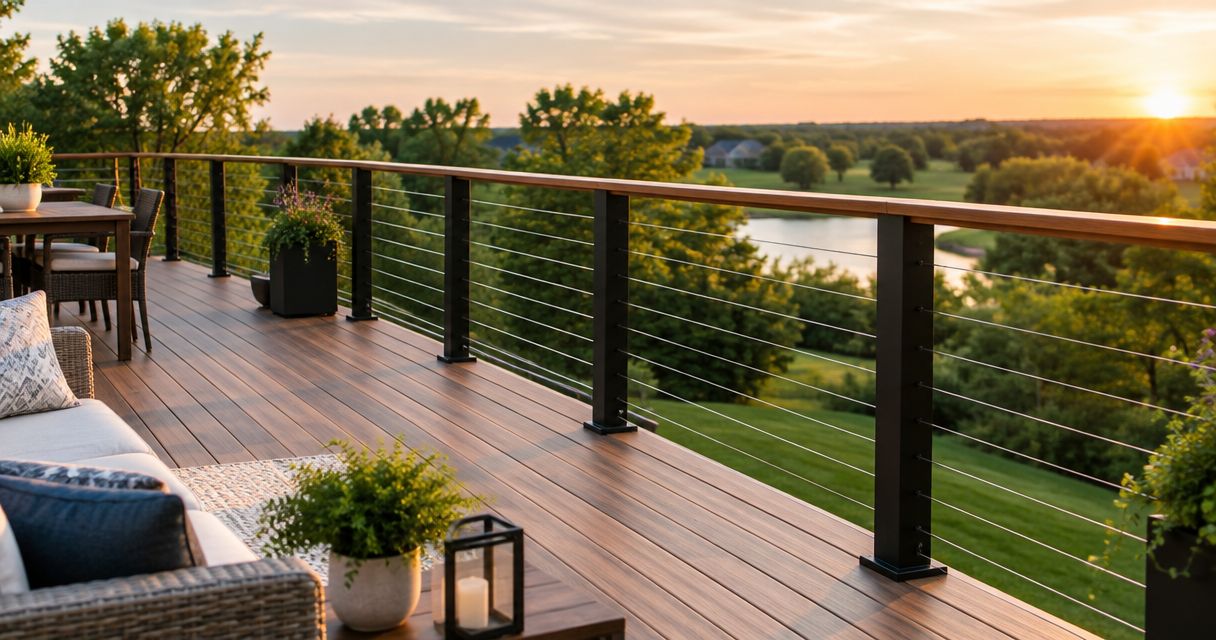
Cable railing uses tensioned stainless-steel cable as infill between supporting posts. Its narrow lines reduce visual obstruction compared with broad balusters or solid panels.
Cable is not a substitute for a designed guard assembly. Tension creates forces at terminal posts, and cable deflection affects the openings between runs. Post stiffness, anchorage and installation instructions matter as much as the cable itself.
Cable pros:
- Narrow infill preserves open sightlines.
- Works with several post and top-rail materials in approved systems.
- Avoids a broad panel surface that needs window-style cleaning.
Cable cons:
- Requires careful tensioning and inspection under the system's instructions.
- Horizontal layouts need local code review, including any applicable climbability restrictions.
Best for: Homeowners whose primary goal is preserving a yard or landscape view.
For a 2026 project, confirm acceptance with the permitting authority before committing to horizontal cable. Do not assume a railing seen on another property is acceptable for your deck.
Verdict: Hold cable until the assembly and local requirements are confirmed.
6. Glass: best for transparent wind screening
Glass railing uses safety-glazing panels in a supporting guard system. Unlike open balusters or cable, the panels interrupt airflow while retaining a transparent view through the railing.
Glass needs glazing-specific design and installation. Panel type, edge support, attachments and any top-rail requirements belong in the system documentation, not in an improvised field detail.
Glass pros:
- Preserves views through clear panels.
- Provides a more continuous wind barrier than open infill.
- Avoids repeated vertical balusters across the view.
Glass cons:
- Water spots, fingerprints and outdoor residue require cleaning.
- Panel replacement and attachment work require glazing-specific details.
Best for: Homeowners who want transparent wind screening and accept regular glass cleaning.
View the proposed location from inside the house as well as from the deck. Reflections and visible residue affect how clear panels look in everyday use. Wind screening also does not turn an exposed deck into an enclosed room.
Verdict: Hold glass until the glazing, attachments and cleaning requirements are settled.
Check guard requirements before ordering
For 2026 planning, the International Residential Code's model provisions for residential deck guards provide useful reference points: guards are generally required where an open-sided walking surface is more than 30 inches above the floor or grade below, measured within the specified horizontal area. Required residential guards are generally at least 36 inches high, and typical guard openings must not allow a 4-inch sphere to pass.
These are model-code reference dimensions, not confirmation of the rules adopted for your address. Stair guards, handrails and certain openings have separate provisions. Commercial projects also require a different review.
Ask your local building department which adopted code and amendments apply. The guide to building permits for a home renovation in Iowa is a starting point for organizing that discussion.
A graspable stair handrail and a deck guard serve different purposes. A wide decorative top rail does not automatically satisfy stair handrail requirements.
Put the complete assembly in the written scope
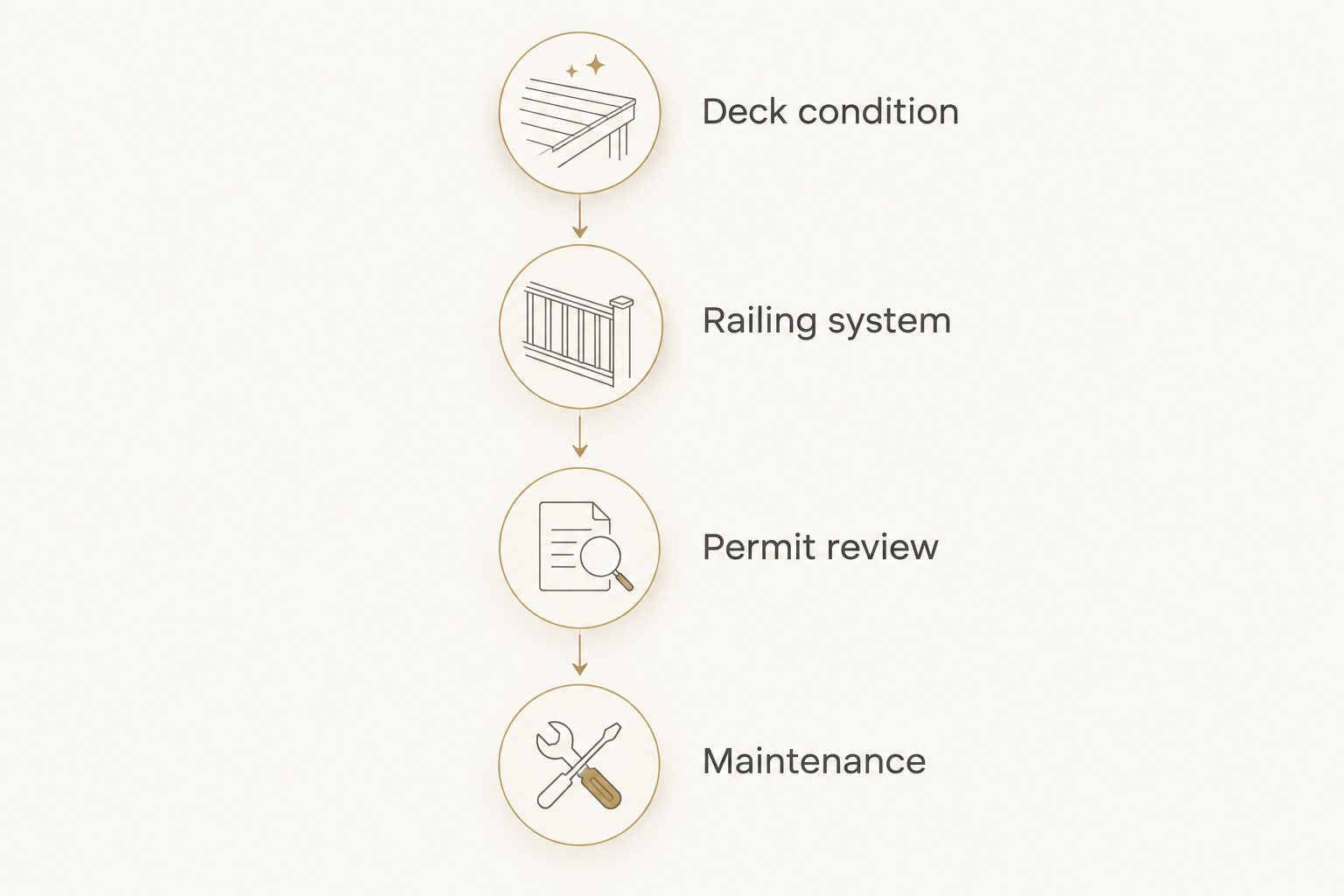
Use this sequence before choosing the final railing material. It keeps a finish decision from getting ahead of structural and permit requirements.
- Deck condition: Identify deteriorated framing, inadequate blocking and unsuitable existing post connections.
- Railing system: Specify the material, posts, infill, brackets, fasteners and stair components as a complete assembly.
- Permit review: Confirm applicable guard and handrail requirements and who handles the permit work.
- Maintenance: Record cleaning, finish repair and inspection instructions for the selected system.
For a 2026 scope discussion with Phoenix Construction Solutions, bring photographs of the deck, stairs and underside connections. Describe whether your priority is less maintenance, a clearer view or traditional detailing. Ask for any proposed railing work, framing repairs and exclusions to be identified separately in writing.
Compare bids on that same scope. Otherwise, one proposal can include structural repairs while another covers only visible railing replacement, making the totals unsuitable for a direct comparison.
Book a Consultation
Discuss your Central Iowa renovation, existing deck condition and written scope.
How the materials are ranked
This ranking favors low routine upkeep, clear system requirements and practical design fit. It is a material-selection guide, not a laboratory test or a comparison of named manufacturers.
Aluminum takes the default position because it avoids recurring wood refinishing without requiring cable tensioning or broad glass-panel cleaning. The remaining choices earn distinct slots: composite for wood-look coordination, vinyl for white designs, wood for custom detailing, cable for sightlines and glass for transparent wind screening.
Which deck railing material should you choose?
Choose powder-coated aluminum unless a specific design requirement points elsewhere. It is the clearest starting point when you want a railing that does not add wood refinishing to your maintenance list.
Choose composite or vinyl for their particular appearance, not because either removes the need to inspect connections. Choose wood when customization matters enough to justify maintenance. Select cable or glass only after confirming the complete system and applicable requirements.
FAQ
What's the best deck railing material for a Central Iowa deck?
Powder-coated aluminum is the best default when your priority is low routine upkeep. It avoids recurring wood refinishing, but its coating, fasteners and structural connections still need inspection.
Is aluminum deck railing better than composite?
Aluminum is the better fit for slim profiles, while composite is the better fit for a substantial wood-look design. Compare complete railing systems, including post reinforcement and stair components, rather than surface materials alone.
Can I put new railing on my existing deck?
New railing requires suitable existing framing and connections. Have the posts, blocking and attachment locations assessed before treating the project as a railing-only replacement.
Is cable railing allowed on decks in Central Iowa?
Cable railing acceptance depends on the code and amendments adopted for your address and the proposed assembly. Confirm the layout, opening limits and any climbability restrictions with the local permitting authority before ordering.
Does glass deck railing block wind?
Glass panels interrupt airflow more than open balusters or cable. The system still needs appropriate safety glazing, panel support and attachments, and the glass requires regular cleaning.
Does deck railing have to match the decking?
Deck railing does not have to use the same material as the decking. Choose compatible colors and profiles, then confirm that the railing attachments work with the deck framing and selected system.
Who can I call about a Central Iowa remodeling project?
Call Phoenix Construction Solutions at (515) 505-8781 to discuss your project. The licensed and insured contractor is based in Carlisle and serves homeowners throughout Des Moines and Central Iowa.
One last thing
The connection beneath the deck boards matters more than the finish above them. Ask to see how each guard post transfers force into the framing; a base plate attached only to decking is not a substitute for a suitable structural connection.
Make that detail part of your selection, not an installation-day question. It is the difference between choosing a railing surface and specifying a complete guard assembly.