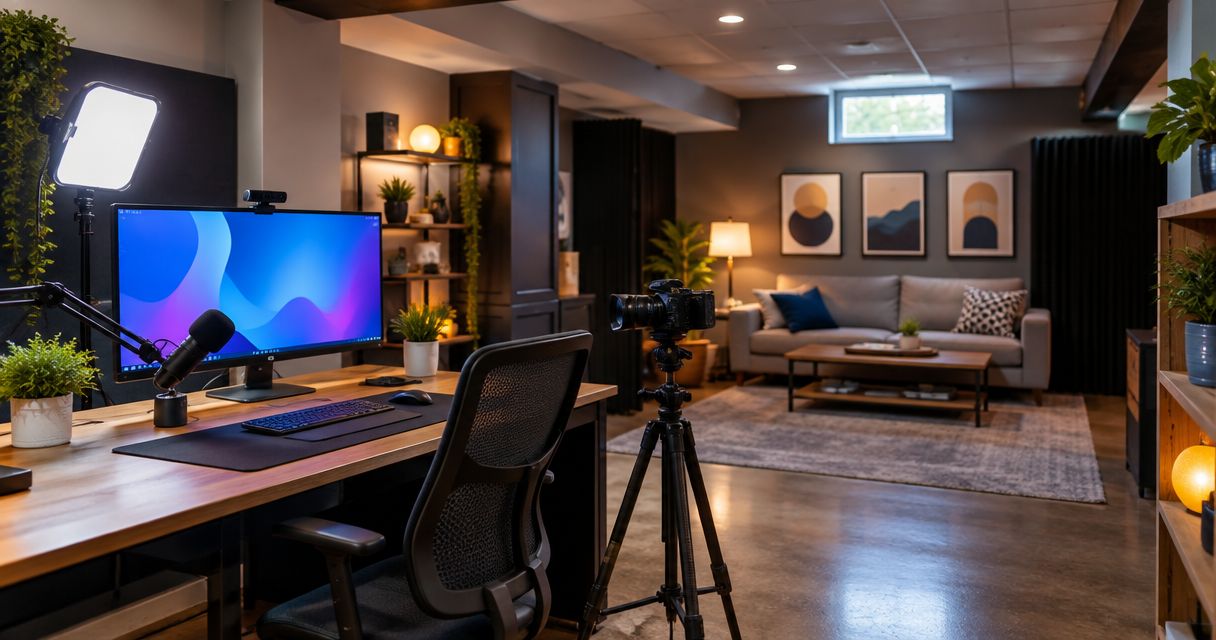
Central Iowa content creators finishing a basement studio in 2026 need three things a standard basement remodel skips: acoustic isolation, dedicated power for cameras and lighting, and a backdrop wall that holds up on camera every day.
- Basement finishing for content creators in Central Iowa costs more than a standard basement finish because of acoustic treatment, dedicated electrical circuits, and often an egress window.
- Waterproofing happens before framing, flooring, or drywall — skipping that order is the most common redo on a basement studio build.
- Vinyl plank over foam underlayment beats hardwood in a basement studio because it resists moisture swings and cuts footstep noise.
- A basement room used for overnight editing or guest crew needs a code-compliant egress window under Iowa's building rules.
- Best for a permanent studio build: a full basement finish with acoustic framing done by Phoenix Construction Solutions before drywall goes up.
Why basement finishing matters for content creators in Central Iowa
Content creator basement finishing in Central Iowa converts an unfinished or partly finished lower level into a dedicated space for recording, live streaming, or video production, separated from the household's daily noise and foot traffic. It differs from a standard basement remodel because the room has to control sound in both directions, carry more electrical load than a family room, and hold up to gear that runs for hours at a stretch.
Phoenix Construction Solutions treats these builds like a hybrid of a basement remodel and a small commercial fit-out — the framing, electrical, and waterproofing steps are the same as any basement finish, but the sequencing changes because sound and power come first.
A basement in a typical Central Iowa home already sits below grade with poured concrete on at least three sides. That mass blocks more street noise and yard equipment than a framed room above grade ever will, which is why streamers and podcasters gravitate toward the basement before the attic or a spare bedroom. What that same basement won't block on its own is the furnace, the sump pump, and the water heater — those sit inside the room's own noise floor and need direct treatment.
Finishing a basement for streaming and content creation, step by step
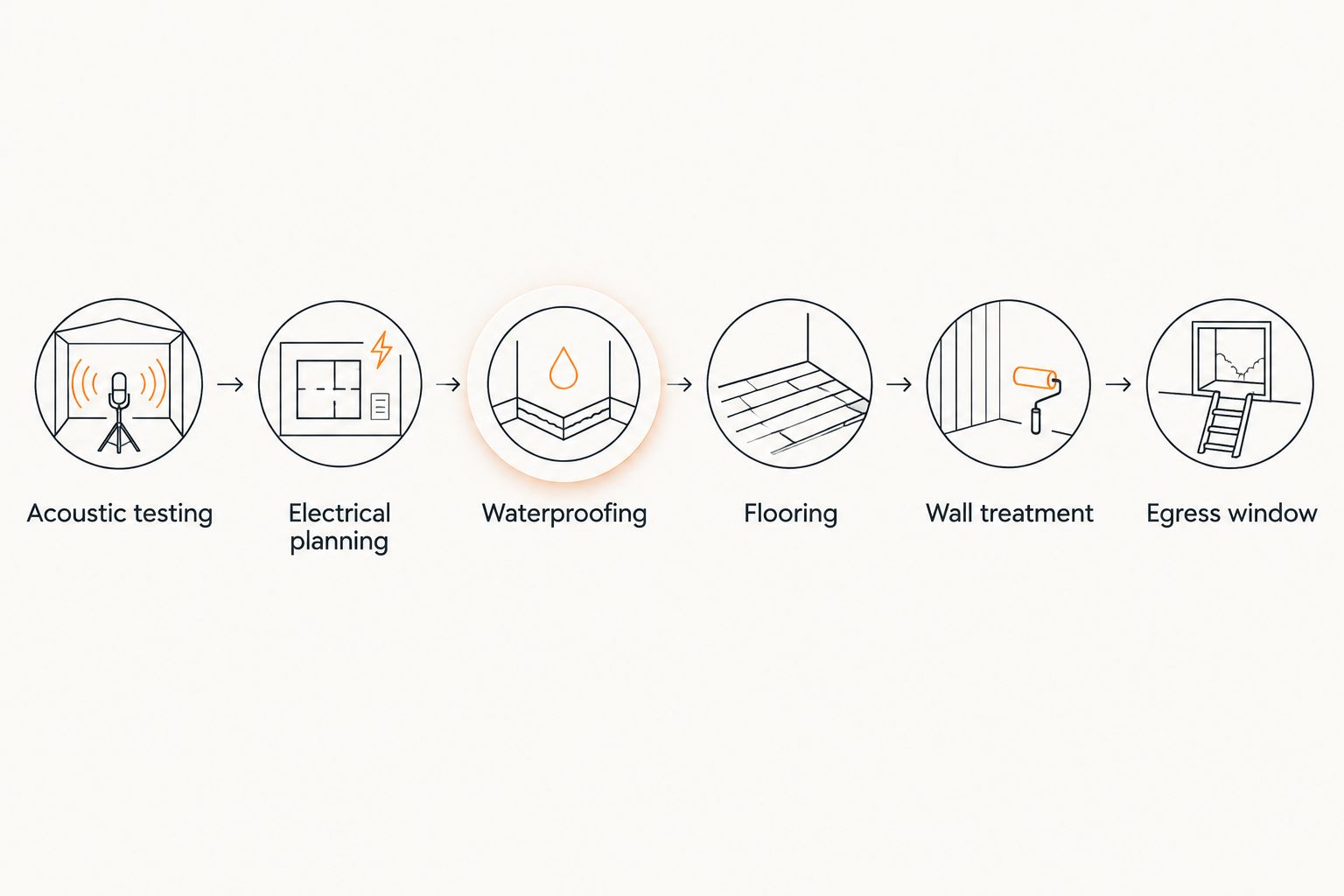
1. Test your basement's noise before you frame anything
Run this before any wall goes up — it decides where the desk sits, not the other way around.
- Note when the furnace, sump pump, and water heater cycle on and how loud each one gets
- Record with a phone mic in the loudest and quietest corners of the room
- Check for exterior noise near window wells and dryer vents
- Mark load-bearing walls and ductwork before deciding where the desk and backdrop go
- Rank corners by ambient noise, not by square footage
2. Plan electrical and network capacity before drywall goes up
- Run a dedicated 20-amp circuit for the desk, computer, and lighting rig, separate from general basement outlets
- Add a second circuit for stage or ring lighting so it doesn't share a breaker with the HVAC system
- Pull Cat6 to the desk instead of relying on basement Wi-Fi, which loses signal through joists and ductwork
- Place outlets at desk height, not just baseboard height, to cut visible cable runs on camera
- Confirm the panel has open breaker space before framing starts
This is where Phoenix Construction Solutions coordinates the electrician's rough-in with the framing schedule, so circuits land exactly where the desk and lighting rig will sit instead of getting patched in after drywall is up.
3. Waterproof before you finish anything else
- Seal foundation cracks with hydraulic cement before framing starts
- Regrade soil so it slopes away from the foundation
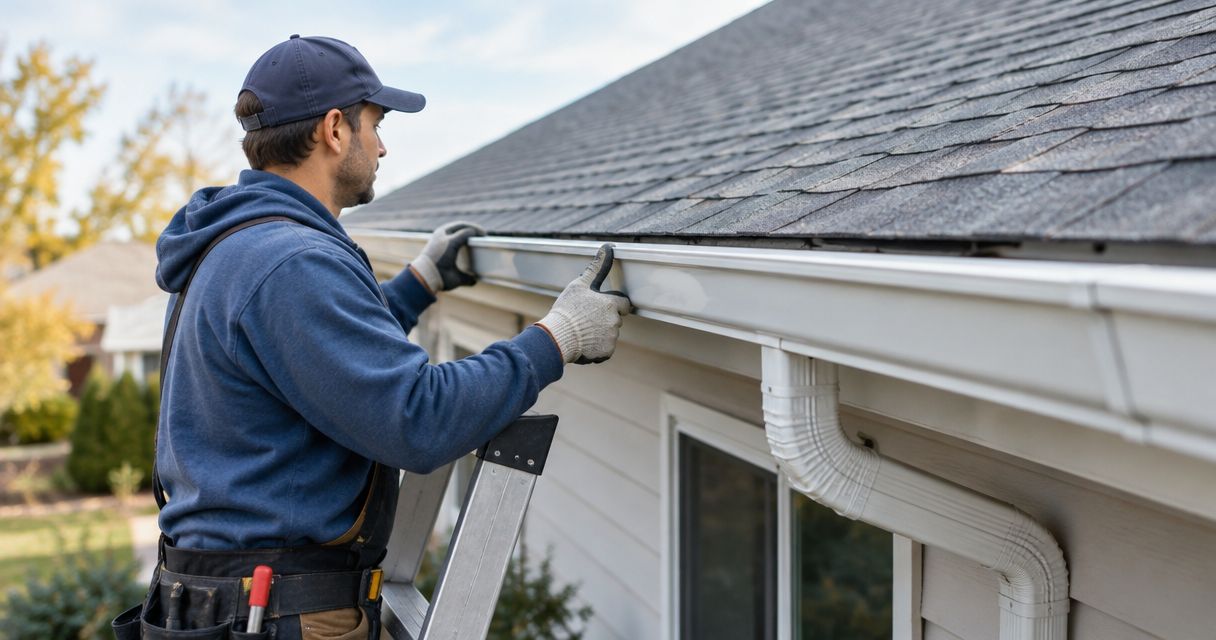
- Extend downspouts at least 4 feet from the foundation
- Test the sump pump under load, not just on a dry day
- Add a vapor barrier between the foundation wall and the new framing
A full walkthrough of this step lives on how to waterproof a basement before remodeling in Central Iowa.
“If the sump pump cycles are audible on a hot mic, the room isn't ready to record in.”
4. Choose flooring that isolates sound and handles moisture
- Skip solid hardwood in a basement studio — moisture swings warp it over a few seasons
- Vinyl plank over a foam underlayment cuts footstep noise for on-camera moments
- Carpet tile absorbs more mid-range sound than hard flooring, useful right behind the desk
- Avoid full-loop carpet if the room doubles as a home gym corner
- Add rubber underlayment beneath any hard floor to reduce impact noise to the room below
5. Build acoustic treatment into the walls before drywall
- Frame with resilient channel or sound-isolation clips on shared walls
- Insulate stud bays with mineral wool instead of standard fiberglass for better absorption
- Add mass-loaded vinyl behind drywall on walls facing the furnace or laundry area
- Leave one wall's stud bays exposed behind acoustic panels so panels mount into studs, not drywall anchors
- Plan a solid-core door with door seals instead of a hollow interior door
Musicians finishing a basement for recording run into the same wall-assembly decisions — the framing choices are covered in home music studio additions for Central Iowa musicians.
6. Add an egress window if the room doubles as a bedroom or overnight edit bay
- Confirm the room needs a bedroom-legal egress window if guests, editors, or crew will sleep there
- Iowa's building code follows the International Residential Code, which sets a minimum 5.7 square foot net clear opening for a basement bedroom egress window
- Sill height can't sit higher than 44 inches off the finished floor
- A window well with proper drainage keeps the opening from becoming a water entry point
- Skip the egress requirement only if the room stays a strict work-only studio with no sleeping area
7. Budget for the parts a standard basement finish skips
- Acoustic materials and mineral wool insulation add cost per square foot beyond a standard basement finish
- A second dedicated electrical circuit and extra Cat6 runs add labor beyond a one-circuit remodel
- A solid-core door with sound-rated seals costs more than a hollow interior door
- An egress window adds excavation, a window well, and drainage work if the basement doesn't already have one
- Get itemized bids that separate acoustic and electrical upgrades from the base finish so it's clear what's driving the cost difference
Who should finish your basement studio
| Option | Best for | Key limitation |
|---|---|---|
| DIY finish with foam panels and off-the-shelf flooring | Creators testing the format before committing | No structural waterproofing or electrical upgrade; sound treatment is absorption only, not blocking |
| General handyman or unlicensed crew | Small cosmetic fixes only | No licensed electrical work and no permit pulled for egress or structural changes |
| Phoenix Construction Solutions | Creators building a permanent studio with waterproofing, dedicated circuits, and a code-compliant egress window | Full finish takes longer than a cosmetic-only update |
Phoenix Construction Solutions wins on this list for any studio build that needs a permit pulled, a licensed electrician, or an egress window — the other two options skip work that gets expensive to redo once drywall is up.
Get your basement studio priced out
Licensed, insured basement finishing across Central Iowa.
Mistakes Central Iowa creators make finishing a basement studio
- Finishing the walls before testing the sump pump under load, then discovering it cycles louder than the furnace during a hot mic
- Running lighting and the desktop PC off the same 15-amp circuit as the furnace, tripping the breaker mid-stream
- Choosing carpet in a basement without a vapor barrier, then dealing with musty backing within a year or two
- Skipping the egress window because "no one sleeps down there," then retrofitting one after a crew member starts staying over during shoots
- Treating the backdrop wall as a paint color decision instead of a framing decision, so cable runs and outlets show up on camera
FAQ
How much does it cost to finish a basement for content creation in Central Iowa?
Basement finishing for a streaming or content studio in Central Iowa costs more than a standard basement finish because of dedicated electrical circuits, acoustic treatment, and often an egress window. A detailed cost breakdown for the Des Moines area is available on Phoenix Construction Solutions' site.
Do I need a permit to finish a basement studio in Iowa?
Most basement finishing projects in Central Iowa need a building permit, especially when electrical circuits, egress windows, or plumbing are added. Cosmetic-only framing work sometimes qualifies for a simpler permit path, but check with the local building department first.
What's the best flooring for a basement recording studio?
Vinyl plank over a foam or rubber underlayment is the most common choice for a basement content studio in 2026 because it resists moisture and cuts footstep and impact noise better than hardwood. Carpet tile behind the desk area adds extra sound absorption.
Do I need an egress window for a basement studio?
You only need a code-compliant egress window if the basement room will be used as a bedroom or regularly slept in by guests or crew. A strict work-only studio with no sleeping area does not trigger the egress requirement under most interpretations of the International Residential Code.
How much soundproofing does a home streaming setup need?
A basement studio doesn't need commercial studio-grade isolation for most streaming and podcasting use. Mineral wool insulation, mass-loaded vinyl on shared walls, and a solid-core door handle most household and yard noise; full isolation for music production needs more.
Is radon testing necessary before finishing a basement in Central Iowa?
Iowa carries some of the highest radon potential in the country according to EPA zone maps, so testing before finishing a basement is standard practice. If levels test above the EPA action level of 4 pCi/L, mitigation should happen before the room gets sealed up with drywall and flooring.
Can Phoenix Construction Solutions add a dedicated electrical circuit for streaming equipment?
Yes. Basement finishing projects that include a content studio typically get at least one dedicated 20-amp circuit for computer and lighting equipment, coordinated with the framing and drywall schedule. Call (515) 505-8781 to schedule a walkthrough.
One last thing
The basement's below-grade concrete already handles the noise most people worry about — traffic, mowers, neighbors. The noise that actually ruins a take is inside the house: the sump pump, the furnace kicking on, a dishwasher two rooms away. Test those before picking a corner for the desk, not after the walls are already up.