Smart home upgrades cost far less when they ride along with a whole home renovation in Central Iowa than when they get bolted on after the drywall goes back up. This guide walks through what to wire, when to wire it, and which upgrades actually hold up through an Iowa winter in 2026.
- Smart home upgrades during a whole home renovation in Central Iowa cost less pre-drywall than as a retrofit.
- Pull low-voltage cable for cameras, hubs, and access points before insulation goes in on any 2026 remodel.
- Smart thermostats pair with energy-efficient renovation upgrades to cut winter heating runtime in Central Iowa homes.
- A 100-amp electrical panel often can't run smart HVAC, an EV charger, and standard appliances at once.
- Skipping panel capacity planning is the single most common smart home mistake in Central Iowa renovations.
Why smart home upgrades matter during a Central Iowa renovation
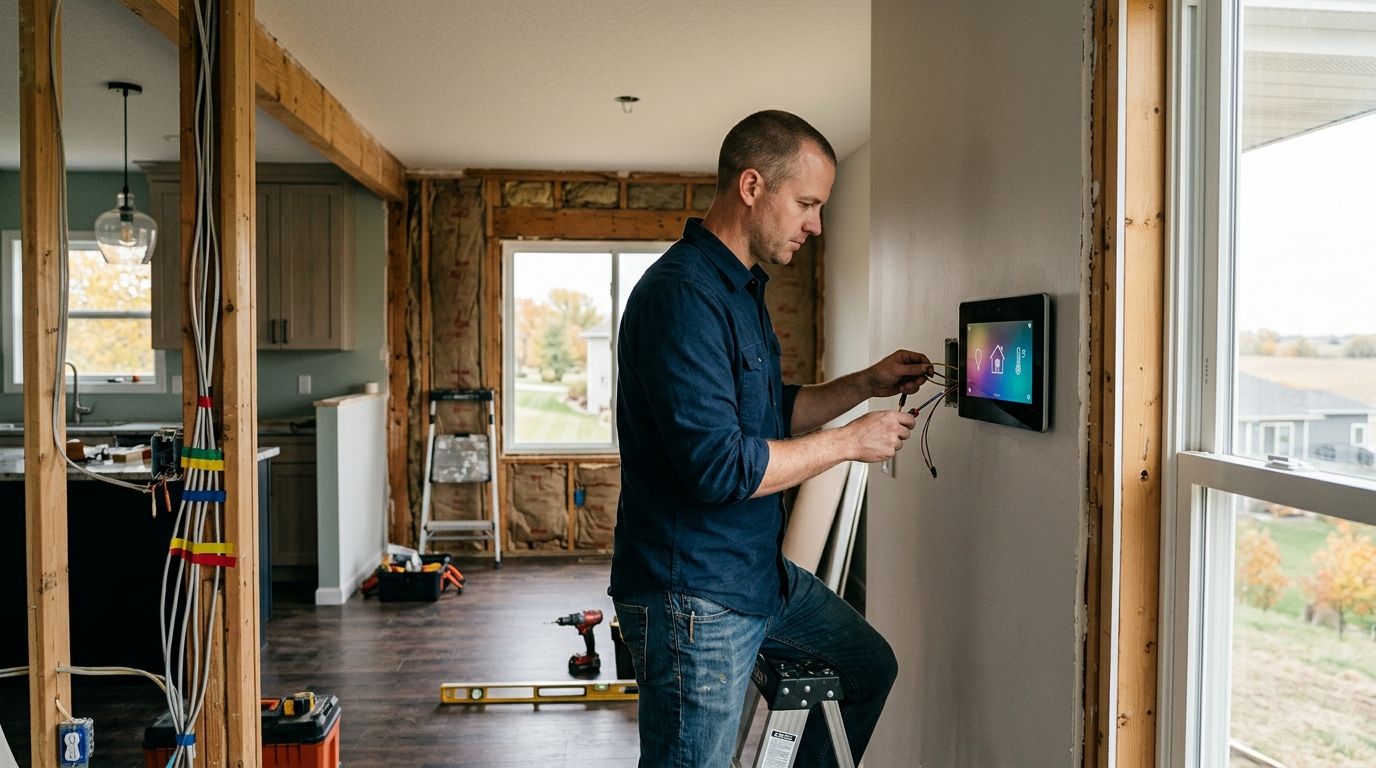
Central Iowa whole-home renovation homeowners get one shot at cheap smart-home wiring: the walls are already open, so running low-voltage cable, upgrading the panel, and adding network drops costs a fraction of what the same work costs after drywall, paint, and trim go back up. Homeowners who wait until move-in usually pay retrofit labor rates just to fish cable through a finished wall.
Central Iowa's climate and housing stock make this different from a coastal remodel. Winters here push furnaces and heat pumps hard from November through March, so a thermostat that actually schedules setbacks earns its keep over a full heating season. Homes in Ankeny, Waukee, and Urbandale built in the 1990s and 2000s often carry 100-amp electrical panels that were never sized for a smart panel, an EV charger, and modern HVAC controls running together — budgeting for a whole-home renovation has to account for panel capacity before any device gets picked out.
Smart home upgrades during a renovation are wiring and electrical decisions first, device decisions second — get the rough-in right and the app choice barely matters.
How to add smart home upgrades to a whole-home renovation
Map the electrical and network plan before demo starts
- Walk every room with the contractor and mark outlet, switch, and data-drop locations before drywall comes down
- List every device wanted in year one and year three — cameras, thermostats, locks, speakers — so wiring doesn't get forgotten
- Confirm panel amperage; a 100-amp panel struggles once smart HVAC, an EV charger, and daily appliances run at the same time
- Decide now between a hardwired network backbone and a Wi-Fi mesh — Cat6 costs less to run while walls are open than after
- Flag any concrete or block walls, common in Central Iowa basements, where retrofitting cable later is close to impossible
Wire for smart infrastructure during demolition
- Run Cat6 to any spot that will hold a router, access point, TV, or security hub
- Pull low-voltage cable to exterior doors and the garage for smart locks and door sensors
- Add conduit or a pull string in wall cavities being closed up, even for devices not yet chosen
- Label every cable run at both ends before insulation goes in
- Rough in a dedicated network closet or panel location near the electrical panel
Upgrade thermostat and HVAC controls
- Confirm the furnace or heat pump is compatible with a smart thermostat's C-wire requirement before buying one
- Set up zone control if the renovation adds square footage, like an addition or a finished basement
- Pair the thermostat with the energy-efficient renovation upgrades already planned — insulation and windows do more for a winter heating bill than the thermostat alone
- Test remote scheduling through a full heating cycle before the crew wraps finish work, not after
- Skip cloud-only thermostats on a rural Central Iowa property with spotty internet; pick one with reliable local scheduling
Add smart lighting and switches during electrical rough-in
- Choose in-wall smart switches over smart bulbs in rooms where guests or renters need a normal light switch
- Run a neutral wire to every switch location, even ones staying standard for now
- Group lighting circuits by room function, not by convenience of run, so scenes and schedules work logically later
- Install occupancy sensors in laundry rooms, mudrooms, and basements where lights get left on
- Keep at least one manual override switch per room in case the smart system fails
Install smart locks and security during exterior work
- Order smart deadbolts that match the door prep before the exterior door install, not after
- Wire doorbell cameras to existing power where possible instead of relying on battery models needing monthly charging
- Add exterior outlets near entry points for future camera or lighting additions
- Plan camera sightlines during the siding or window phase, before scaffolding comes down
- Coordinate lock and camera brands so they run through one app instead of three
Automate water and leak detection during plumbing work
- Place leak sensors at the water heater, washing machine, and any basement plumbing before walls close
- Add a smart shutoff valve at the main line if the renovation already involves re-piping
- Run a low-voltage line to sensor locations so battery swaps aren't the only option
- Test every sensor against the phone app before the plumber leaves the job
- Prioritize basements — Central Iowa's freeze-thaw cycles and spring rain make basement leaks one of the most common claims in the region's older housing stock
Add accessibility-friendly smart features for aging in place
- Wire voice-activated lighting near beds and bathrooms so switches aren't required at night
- Pair smart locks with video doorbells so mobility-limited residents can screen visitors without walking to the door
- Add smart water shutoffs near tubs and showers as a backup to grab bars and non-slip flooring covered in aging-in-place bathroom remodeling
- Install fall-detection sensors only where a family member will actually monitor the alerts
- Keep controls on a single app so an older resident isn't juggling four logins
Centralize controls and budget the upgrade inside the renovation
- Pick one ecosystem for thermostat, locks, lighting, and security before buying devices piecemeal
- Confirm the hub works on local network standards, not just cloud connections, for reliability during Central Iowa winter outages
- Get rough-in electrical and low-voltage wiring priced as a line item on the contractor's bid, not a separate visit
- Hold back 5-10% of the smart-home line item for devices decided on later in the project
- Ask which upgrades need a licensed electrician versus what a homeowner can add after the renovation wraps
Smart home options for a Central Iowa renovation compared
| Option | Best for | Key limitation |
|---|---|---|
| Smart thermostat | Homeowners upgrading HVAC during the renovation | Needs a compatible furnace or heat pump and stable Wi-Fi |
| Smart lighting (in-wall switches) | Renovations with electrical rough-in already open | Requires a neutral wire at every switch box |
| Smart locks | Exterior door replacement projects | Battery models need regular upkeep in cold weather |
| Leak sensors + shutoff valve | Basement remodels and re-piping projects | Only protects the exact spot the sensor sits |
| Whole-home hub | Households running three or more smart categories | Locks devices into one ecosystem's compatibility list |
Buy the thermostat and locks during the renovation. Wait on the whole-home hub until the ecosystem is picked, not before.
Common mistakes Central Iowa renovation homeowners make with smart home upgrades
- Buying devices before the electrical plan is final, then finding the switch box has no neutral wire
- Skipping panel capacity checks and discovering mid-renovation that a 100-amp panel can't run smart HVAC and an EV charger together
- Treating basement leak sensors as optional in a region where spring rain and snowmelt drive most water-damage claims
- Choosing cloud-only devices for a rural Waukee or Norwalk property with inconsistent broadband
- Closing up walls without pulling extra low-voltage cable, then paying retrofit rates a year later for a device that wasn't even on the market during the 2026 renovation
Plan smart wiring into your renovation
Phoenix Construction Solutions coordinates electrical rough-in during Central Iowa remodels.
FAQ
What's the best time to add smart home upgrades during a renovation?
The best time is during electrical rough-in, before drywall closes the walls. Running Cat6 and low-voltage cable at this stage costs far less than fishing it through finished walls later.
Is it cheaper to wire for smart home devices during a renovation than after?
Yes. Wiring during an open-wall renovation avoids retrofit labor, patching, and repainting that a post-renovation smart home project requires.
Do I need a new electrical panel for smart home upgrades?
It depends on the panel's amperage. Homes with 100-amp panels often need an upgrade before adding a smart panel, EV charger, and modern HVAC controls together.
Can I add a smart thermostat without a C-wire?
Some thermostats work with an adapter, but reliability varies. Running a dedicated C-wire during the renovation avoids the workaround entirely.
Are smart locks reliable in Iowa winters?
Battery-powered smart locks need more frequent charging in cold weather. Wiring the lock to existing power during exterior door work is more consistent through a Central Iowa winter.
Should I choose one smart home ecosystem or mix brands?
Pick one ecosystem before buying devices piecemeal. Mixing brands across thermostat, locks, and lighting usually means juggling separate apps instead of one control point.
How much low-voltage cable should I run during a whole-home renovation?
Run cable to every spot that could hold a router, camera, or hub, plus a few extra pulls to rooms without a planned device yet. Retrofitting a single missed run later costs more than several extra runs during the renovation.
What's the biggest smart home mistake Central Iowa renovation homeowners make?
Skipping the panel capacity check. Adding smart HVAC controls, an EV charger, and standard appliances to a 100-amp panel is the most common bottleneck discovered mid-project.
One last thing
Pull extra Cat6 runs to the attic and the basement mechanical room even without a device for them yet in 2026 — those two spots are the hardest and most expensive to reach once insulation and finished ceilings go back in, and by 2027 or 2028 most households own at least one device that needs that exact connection.