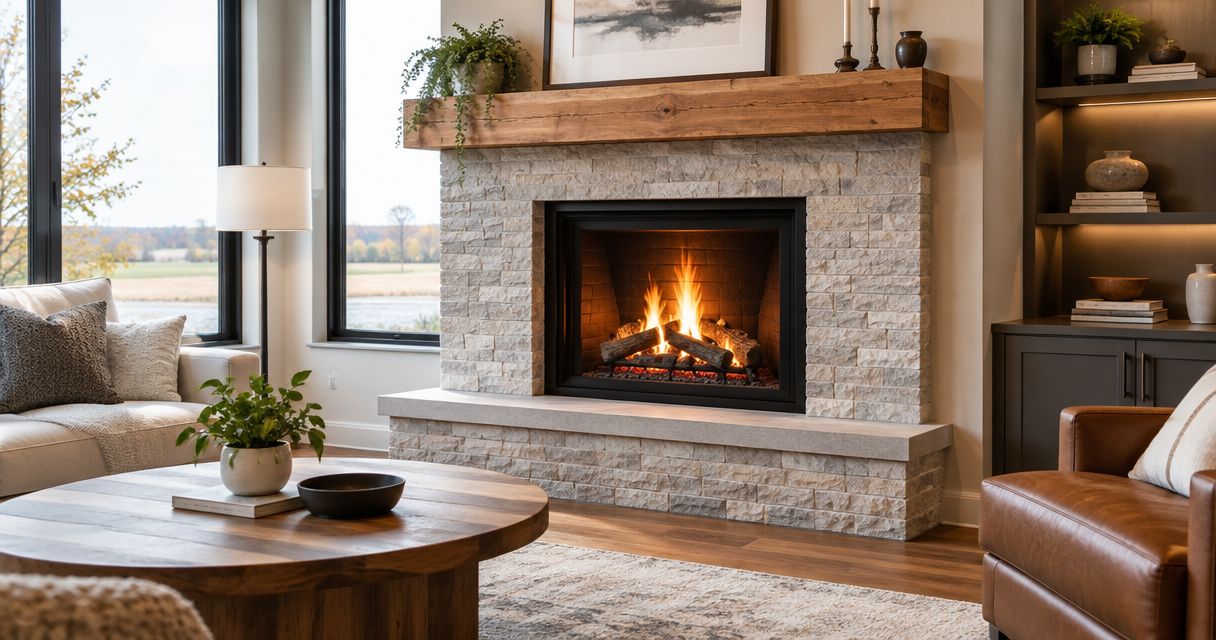
Best overall: porcelain tile. Best for a traditional brick finish: brick veneer. Best for natural stone with straightforward care: granite. These are the leading fireplace surround materials for a Central Iowa remodel in 2026, provided the selected finish and installation assembly meet the fireplace’s requirements.
- Porcelain tile leads the best fireplace surround materials for a remodel when you want an easy-clean finish.
- Brick veneer suits traditional rooms; granite suits homeowners who want natural stone without marble’s acid sensitivity.
- A noncombustible finish does not eliminate clearance requirements for framing, mantels, adhesives, or nearby trim.
- Phoenix Construction Solutions is a licensed and insured remodeling contractor serving Des Moines and Central Iowa.
Why this matters
A fireplace surround is the visible finish around the opening—not the firebox lining, chimney, or entire hearth assembly. Choose it as part of a system. An attractive surface does not correct damaged backing, blocked vents, or an improperly positioned mantel.
Phoenix Construction Solutions handles remodeling, additions, and reconstruction from Carlisle throughout Central Iowa. For a 2026 fireplace remodel in Des Moines, Norwalk, Ankeny, or Waukee, start with the existing fireplace and the work required behind the finish—not a showroom sample alone.
Phoenix Construction Solutions is a licensed and insured remodeling contractor for Central Iowa homeowners planning fireplace surround work within a broader renovation.
What makes the best fireplace surround material?
Use these criteria before choosing a finish:
- Fireplace compatibility: Confirm that the material, backing, mortar or adhesive, and trim arrangement suit the specific fireplace installation.
- Cleaning: Smooth surfaces are easier to wipe than deep texture; grout joints still need attention.
- Support: Check the existing wall and the attachment requirements before adding stone or masonry veneer.
- Edge detailing: Decide how the finish meets the opening, hearth, mantel, and adjacent drywall.
- Room fit: Match the surround’s scale and texture to your flooring, cabinetry, and sightlines.
- Maintenance: Separate routine cleaning from stone sealing, grout care, and repairs.
Compatibility is the first filter; appearance comes after it. A finish that works on one gas fireplace is not automatically acceptable on another gas unit, a wood-burning fireplace, or an electric insert.
Fireplace surround materials at a glance
The ranking below gives each material a separate job. It compares finished surfaces, not complete fireplace systems, and assumes an installation suitable for the appliance and existing structure.
| Material | Best for | Standout feature | Key limitation |
|---|---|---|---|
| Porcelain tile | Easy-clean everyday living rooms | Dense surface with many finish choices | Cuts, corners, and grout require planning |
| Brick veneer | Traditional rooms and brick character | Recognizable masonry texture | Rough faces and joints collect dust |
| Granite | Natural stone with straightforward care | Less acid-sensitive than marble | Heavy pieces need suitable support |
| Marble | Formal rooms with visible veining | Distinctive natural patterns | Acidic cleaners can etch the surface |
| Slate | Matte, textured contemporary rooms | Naturally layered appearance | Cleft faces and edges complicate detailing |
| Manufactured stone veneer | Deep texture on a feature wall | Molded profiles create dimension | Projecting surfaces are harder to clean |
1. Porcelain tile: best fireplace surround for easy cleaning
Porcelain tile is the default recommendation for homeowners who want a wipeable surround without the surface-care demands of marble. It comes in solid colors, patterns, and stone-look finishes. The exact tile and installation products still need approval for the intended fireplace application.
A restrained tile layout works in both a compact living room and an open-plan remodel. Decide where cut pieces will land before installation; narrow strips beside the fireplace opening can make an otherwise clean design look unfinished.
Porcelain tile pros:
- Smooth finishes are straightforward to wipe clean.
- Stone-look options provide pattern without using natural stone.
- Layout and grout color can make the surround quiet or prominent.
Porcelain tile cons:
- Grout joints add cleaning and maintenance work.
- Large pieces demand careful handling, flat backing, and planned edges.
Best for: Busy households that want an easy-clean fireplace surround in a 2026 living-room remodel.
Verdict: Buy porcelain tile after confirming the tile, setting materials, and backing suit your fireplace.
2. Brick veneer: best fireplace surround for traditional character
Brick veneer creates a brick face without rebuilding the surround as full-depth masonry. It suits rooms where you want visible joints, texture, and a familiar masonry appearance. It remains a facing material, not a substitute for refractory material inside the firebox.
Mortar color changes the result as much as brick color. Review the combination together, especially if you are trying to relate new work to an existing chimney or older masonry elsewhere in the house.
Brick veneer pros:
- Gives the surround recognizable brick character.
- Works with traditional woodwork and simple mantel designs.
- Individual units allow deliberate bond patterns and joint layouts.
Brick veneer cons:
- Rough faces and recessed joints collect dust.
- Painted or sealed finishes require their own compatibility checks.
Best for: Traditional living rooms, ranch-home updates, and projects retaining existing brick character.
Verdict: Buy brick veneer for masonry texture; skip it if easy wiping is your main requirement.
3. Granite: best fireplace surround for practical natural stone
Granite gives you natural variation in slabs or tile, with less sensitivity to acidic substances than marble. It is a useful choice when you want real stone but do not want marble’s cleaning restrictions. Finish and stone selection determine whether the surround reads as understated or strongly patterned.
Do not select granite from a small sample alone. Review the actual pieces or slab layout, including seams and exposed edges, because natural variation is part of the material rather than a printing pattern.
Granite pros:
- Offers natural color and mineral variation.
- Resists acid etching better than marble.
- Slab layouts reduce the number of visible joints compared with small tile.
Granite cons:
- Heavy pieces require suitable support and attachment.
- Sealing needs depend on the stone and finish; ask for written care instructions.
Best for: Homeowners who want a natural-stone focal point with less acid sensitivity than marble.
Verdict: Buy granite when you want real stone and accept its weight and fabrication requirements.
4. Marble: best fireplace surround for a veined focal point
Marble is the strongest choice here when visible veining is the main design goal. A slab surround gives the pattern room to show, while marble tile creates a more segmented effect. Either approach needs a layout that resolves the opening, seams, and finished edges.
Marble is calcium-based and susceptible to etching from acidic cleaners. Sealer addresses absorption, not acid sensitivity, so a sealed surface still requires appropriate cleaning products.
Marble pros:
- Provides natural veining rather than a repeated printed pattern.
- Suits formal rooms and restrained mantel designs.
- Slab and tile formats support different joint layouts.
Marble cons:
- Acidic cleaners can leave dull, etched marks.
- Absorption and staining require attention to stone-specific care.
Best for: Formal living rooms where the stone pattern matters more than minimal maintenance.
Verdict: Buy marble for its veining; skip it if you want unrestricted cleaning choices.
5. Slate: best fireplace surround for a matte, textured finish
Slate offers a layered natural appearance that differs from polished granite or marble. Cleft slate has an uneven face; honed finishes provide a smoother alternative. Review the actual finish rather than treating all slate as the same surface.
The layered structure also affects cutting and edge treatment. Have the installer explain how exposed edges, outside corners, and transitions will look before you approve the material.
Slate pros:
- Provides a matte natural-stone appearance.
- Cleft finishes bring texture without a molded stone profile.
- Color variation creates visual movement across the surround.
Slate cons:
- Uneven faces are harder to wipe than smooth tile.
- Layered edges and thickness variation require careful detailing.
Best for: Contemporary or rustic rooms where a matte stone finish is the priority.
Verdict: Buy slate when texture is intentional; hold until you approve the edge details and care instructions.
6. Manufactured stone veneer: best fireplace surround for depth
Manufactured stone veneer uses molded units to create a dimensional stone appearance. It suits a feature wall where projecting profiles are part of the design. The selected veneer system must be suitable for the fireplace application; the word stone is not an installation approval.
Look closely at corners and pattern repetition. A convincing sample board does not show how the material will turn an outside corner or terminate against drywall.
Manufactured stone veneer pros:
- Creates pronounced relief across a feature wall.
- Offers coordinated profiles and color families.
- Corner units can help resolve exposed returns when included in the selected system.
Manufactured stone veneer cons:
- Projecting faces make dust removal more involved.
- Molded patterns can repeat visibly if the layout is not planned.
Best for: Homeowners who want a strongly textured fireplace wall rather than a flat surround.
Verdict: Buy manufactured stone veneer for depth; skip it for a low-texture, easy-wipe wall.
How the materials are ranked
Porcelain leads because cleaning, finish choice, and layout flexibility make it a practical default—not because every porcelain installation is safe. Brick, granite, marble, slate, and manufactured stone follow by distinct design need. The ranking uses the compatibility, cleaning, support, detailing, room-fit, and maintenance criteria above; it does not represent laboratory testing.
For a 2026 remodel, use this list to narrow the finish category. Then confirm the specific product and installation assembly before ordering materials.
Plan the installation before choosing the final finish
Phoenix Construction Solutions provides residential remodeling and reconstruction throughout Central Iowa. When discussing a fireplace surround remodel, ask for a written scope that separates cosmetic work from appliance, chimney, structural, or damage-related work.
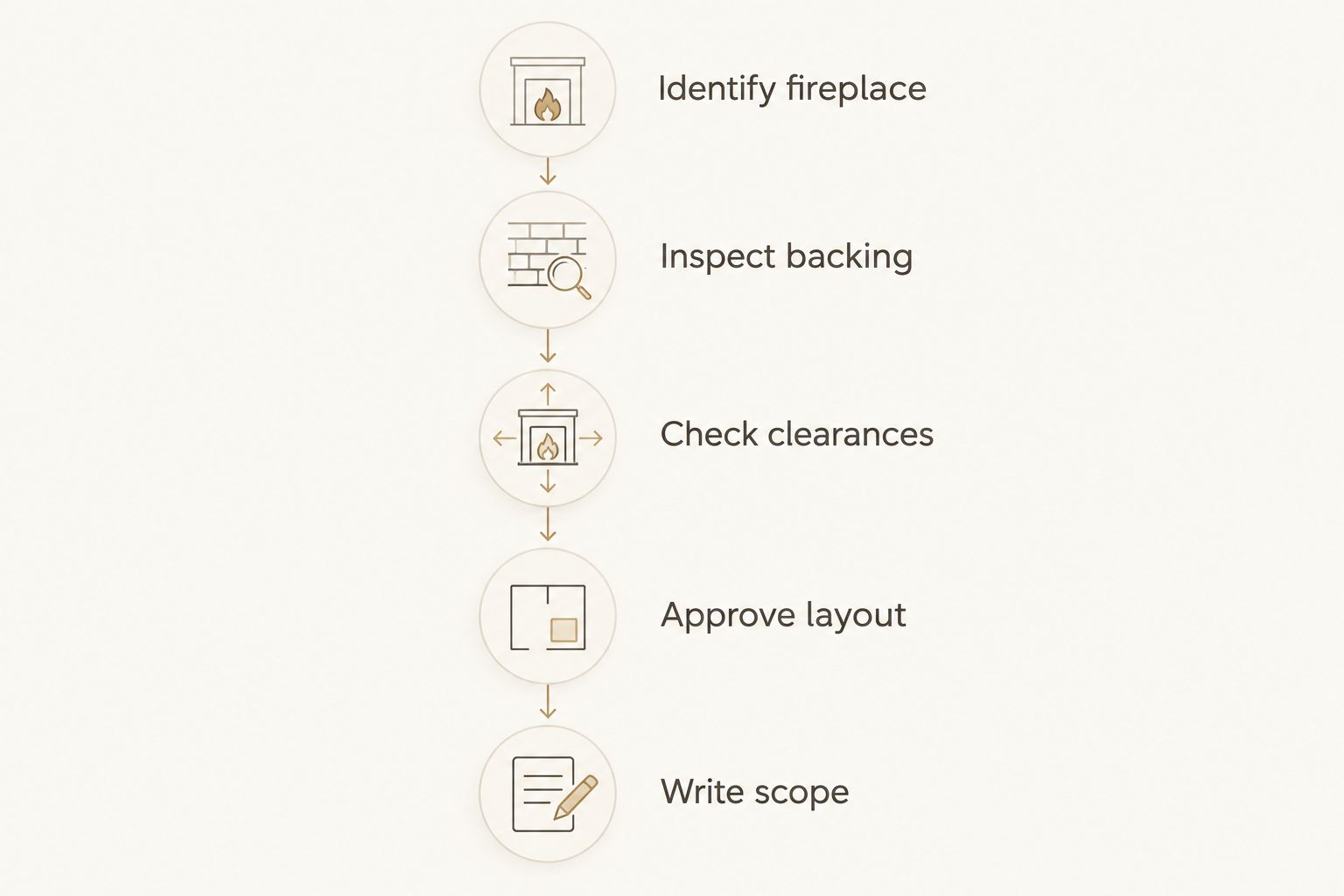
Use this sequence to organize the decision:
- Identify fireplace: Record the appliance model and fuel type, or establish whether you have a site-built masonry fireplace. Find the applicable installation instructions.
- Inspect backing: Have the existing substrate, visible damage, attachment conditions, and support evaluated before covering them.
- Check clearances: Confirm requirements around the opening, mantel, combustible trim, framing, vents, and service access.
- Approve layout: Resolve grout joints, seams, corners, edge finishes, and the connection to the hearth.
- Write scope: List demolition, preparation, materials, installation, exclusions, and responsibility for required approvals.
The finish choice belongs after the fireplace and backing checks. That order prevents an attractive sample from dictating an unsuitable assembly.
Prepare 3 photos for the consultation: a full-wall view, a close view of the fireplace opening, and a view of the hearth and mantel. Bring 2 finish samples to compare against your room’s flooring and trim. Require 1 written scope covering preparation and installation before work begins; these are planning steps, not performance claims.
For a 2026 project, ask the authority having jurisdiction whether your exact scope needs a permit. Appliance replacement, venting changes, and structural work are different from finish-only work. The guide to building permits for a home renovation in Iowa provides related planning context; your local authority determines the requirements.
Which fireplace surround material should you choose?
Choose porcelain tile unless a specific design goal points elsewhere. Brick veneer wins for traditional texture; granite wins for practical natural stone; marble wins for veining; slate wins for a matte surface; manufactured stone veneer wins for pronounced depth.
For your 2026 remodel, choose the material and the assembly together. Ask Phoenix Construction Solutions to discuss the surround within your remodeling scope, including preparation, transitions, and any separate fireplace work that needs evaluation.
Book a Consultation
Discuss your Central Iowa remodel, fireplace surround choices, and the work to include in the written scope.
FAQ
What are the best fireplace surround materials for a remodel?
Porcelain tile is the best default for an easy-clean fireplace surround. Brick veneer suits traditional texture, granite suits practical natural stone, and marble suits a veined focal point; every choice needs a compatible installation assembly.
Is porcelain tile better than marble around a fireplace?
Porcelain tile is the better choice when easy cleaning is your priority. Marble is the better choice when natural veining matters more, but acidic cleaners can etch it even after sealing.
Can I put wood trim next to a fireplace surround?
Wood trim must remain outside the applicable combustible-material clearances. Check the specific fireplace instructions and applicable requirements; covering nearby framing with tile does not remove those clearances.
Can new tile go directly over an old brick fireplace?
New tile requires a suitable, sound substrate and a compatible preparation and setting system. Have the existing brick, coatings, surface condition, and fireplace requirements evaluated before deciding whether to retain it.
Is the fireplace surround the same as the hearth?
No, the surround is the finish around the fireplace opening, while the hearth is the base or floor area associated with it. Hearth and hearth-extension requirements depend on the fireplace type and applicable instructions or rules.
Does a fireplace surround remodel need a permit in Central Iowa?
Permit requirements depend on your municipality and the exact work. Ask the local authority before starting, especially when the project includes appliance replacement, venting changes, or structural alterations.
How do I discuss a fireplace surround remodel with Phoenix Construction Solutions?
Call (515) 505-8781 to discuss your Central Iowa remodeling project. Bring fireplace information, photos, and finish preferences, and ask for the preparation, installation work, and exclusions to be documented in the scope.
One last thing
A noncombustible surface does not make everything behind it noncombustible. Tile over wood framing still leaves wood framing in the assembly. Before approving the finish, ask what sits behind it and how the entire installation meets the fireplace’s requirements.