Central Iowa wine collectors turning basement square footage into cellar space face a problem most cellar guides ignore: this region's humidity swings harder between July and January than almost anywhere else in the Midwest, and an unconditioned basement corner will not hold a collection past one summer. A basement wine cellar built for Des Moines-area conditions needs vapor control, dedicated cooling, and moisture-resistant materials before a single rack goes in — not as upgrades, as the baseline.
- A basement wine cellar in Central Iowa needs 55-58°F and 50-70% relative humidity held year-round, not just in summer.
- Waterproofing and vapor barriers come before framing or racking — skip this step and mold shows up within a season.
- Passive basement corners fail in Iowa because summer humidity outside runs 65-80%, pulling moisture straight through unsealed concrete.
- Phoenix Construction Solutions builds basement wine cellars for collectors across Des Moines, Ankeny, Waukee, and West Des Moines.
- A dedicated mini-split cooling unit, not a window AC or open vent, is the only reliable way to hold cellar temperature in this climate.
Why this matters for Central Iowa collectors
A Des Moines-area basement runs 15-25 degrees cooler than the main floor most of the year, which sounds ideal for wine storage — until August, when outdoor humidity climbs into the 70s and unsealed basement walls sweat. Iowa's clay-heavy soil also pushes groundwater against foundation walls every spring thaw, which is why waterproofing a basement before remodeling has to happen before cellar construction starts, not after a moisture problem shows up. Collectors who skip this step end up chasing mold in the drywall within a year or two, long after the racking and lighting are installed.
A basement wine cellar built correctly for this climate stays inside 55-58°F with humidity between 50% and 70% every month of the year, including the deep-freeze stretches in January and the humid stretch in July and August. That range is not a suggestion — cork dries out below 50% humidity and mold sets in above 70%, and both extremes hit an Iowa basement without a sealed, conditioned room.
Assess your basement's moisture baseline first
Before anything gets framed, know what the space is actually doing. A moisture reading taken in February tells you nothing about August conditions in the same room.
- Run a hygrometer in the target space for two full weeks, spanning at least one rain event
- Check for efflorescence (white mineral staining) on foundation walls, a sign of water moving through concrete
- Test the area nearest the sump pump separately — it runs wetter than the rest of the basement
- Note any musty smell, which signals existing mold even without visible staining
- Confirm grading and gutters direct water away from the foundation on that side of the house
Waterproof and insulate before you build the room
This is the step collectors skip because it doesn't show up in the finished photos, and it's the step that determines whether the cellar lasts five years or fifteen.
- Seal foundation cracks and apply an interior waterproof coating on exterior-facing walls
- Install rigid foam insulation against the concrete, not fiberglass batts, which hold moisture against masonry
- Add a continuous vapor barrier behind the interior wall framing, taped and sealed at every seam
- Confirm the sump pump has a battery backup — a cellar with a flooded sump during a power outage loses a collection fast
- Frame walls with pressure-treated bottom plates against the slab
Choose a vapor-barrier and framing approach built for cold storage
Standard basement framing assumes room-temperature living space on both sides of the wall. A wine cellar holds 55-58°F against a basement that might sit at 68°F outside the room, and that temperature gap drives condensation if the vapor barrier isn't continuous.
- Seal the vapor barrier on the warm side of the insulation, facing the rest of the basement
- Use an insulated, weatherstripped cellar door — a standard hollow-core interior door leaks conditioned air fast
- Insulate the ceiling of the cellar if there's living space above, not just the perimeter walls
- Avoid recessed can lights that penetrate the vapor barrier and ceiling insulation
- Caulk every penetration point where plumbing or electrical lines cross the barrier
Install a dedicated cooling and humidity system
A window unit or a vent tied into the home's main HVAC will not hold 55-58°F consistently — both are built for comfort cooling, not wine storage tolerances.
- Size a dedicated wine cellar cooling unit (ductless mini-split, self-contained, or through-wall) to the exact cubic footage of the finished room
- Add a standalone humidifier or dehumidifier depending on which direction the room drifts — most Iowa basements need dehumidification in summer and humidification in winter
- Install a remote monitoring sensor so temperature and humidity swings show up before bottles are affected
- Route condensate drainage from the cooling unit to an existing floor drain or the sump pit
- Set the unit on a dedicated circuit, separate from the basement's general lighting or outlet circuit
Pick flooring and lighting that won't sweat or fade labels
What goes on the floor and what shines on the bottles matters more in a cellar than in any other basement room.
- Choose tile, sealed concrete, or cork over carpet or laminate — moisture-tolerant surfaces that won't trap humidity (basement flooring options built for Iowa basements cover the full comparison)
- Use low-heat LED fixtures; incandescent bulbs raise room temperature and fade labels over time
- Keep direct light off bottles in racking — UV exposure degrades wine even at cellar temperature
- Avoid ceiling fans or open-air circulation that disrupts the still air wine storage needs
Plan racking and layout for your actual collection size
Racking gets bought for the collection someone wishes they had, not the one they own — and that mismatch either wastes square footage or forces a second buildout in three years.
- Measure current bottle count and add 30-40% for realistic growth over five years
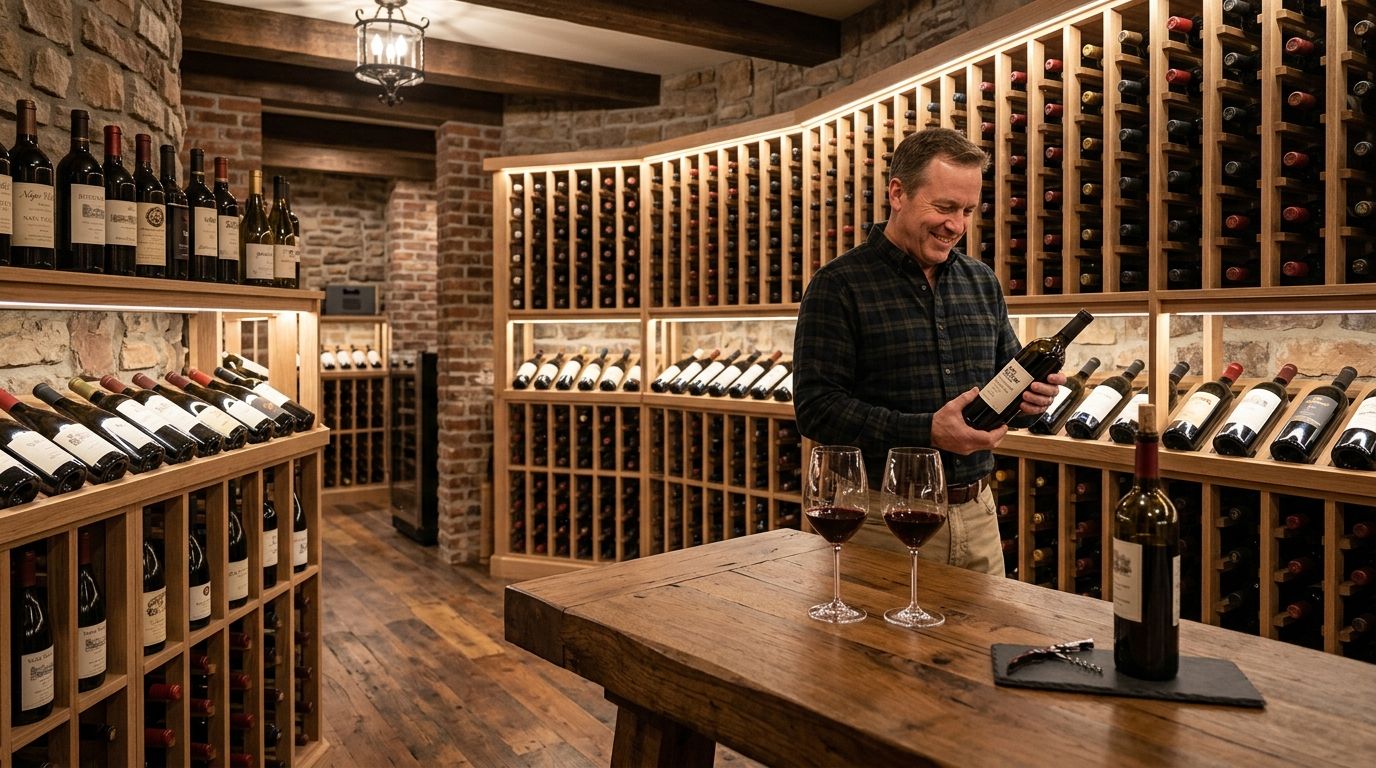
- Mix diamond bins for everyday bottles with individual slots for bottles being aged long-term
- Leave a minimum 30-inch aisle for standing access, more if a tasting table is planned
- Reserve wall space near the door for a small counter or tasting surface if the room allows it
Handle electrical, drainage, and code details Iowa inspectors check
A finished basement room in Central Iowa needs a permit in most jurisdictions once electrical, framing, or a change of use is involved, and inspectors check specific things in a below-grade room.
- GFCI protection on any outlet within reach of moisture sources, including near the cooling unit
- Proper egress isn't required for a wine cellar itself unless it's classified as a habitable room
- Smoke and carbon monoxide detector placement per current Iowa residential code
- Confirm the electrical circuit for the cooling unit is sized and permitted correctly, not tapped off an existing basement circuit
Comparing wine storage options for Central Iowa basements
| Option | Best for | Key limitation | Verdict |
|---|---|---|---|
| Freestanding wine fridge/cabinet | Small collections, renters, quick setup | Limited capacity, no room for tasting or display | Buy for under 50 bottles |
| Passive unconditioned basement corner | Nobody, in this climate | Fails to hold humidity range through Iowa summers | Skip |
| Insulated room with dedicated mini-split | Serious collectors with 100+ bottles | Requires waterproofing and permitted electrical work first | Buy for a real collection |
| Full custom cellar build-out with tasting area | Collectors who entertain and display the collection | Highest upfront construction scope | Buy if space and budget allow |
Common mistakes Central Iowa collectors make
- Skipping waterproofing to save time. Framing over an unsealed foundation wall guarantees a moisture problem within a year in this soil type.
- Using a window AC unit instead of dedicated cooling. It cools the room but doesn't manage humidity, and cork dries out even at the right temperature.
- Underestimating summer humidity. Iowa basements can hit 70%+ relative humidity in July and August without mechanical dehumidification, well outside the safe range for a collection.
- Building the room before checking sump pump reliability. A cellar next to a sump pit with no battery backup is one power outage away from a flooded room.
- Buying racking for an aspirational collection size. Oversized racking eats usable floor space that a tasting counter or seating area could use instead.
“If the room swings more than a few degrees between July and January, the cork fails before the wine does.”
Phoenix Construction Solutions is a licensed, insured contractor based in Carlisle, Iowa, handling basement wine cellar builds — waterproofing, framing, and finish work — for collectors across Des Moines, Ankeny, Norwalk, Pleasant Hill, Urbandale, Waukee, and West Des Moines. A basement wine cellar in this region is a construction project first and a design project second, and getting the waterproofing and cooling right in 2026 determines whether the room still protects a collection in 2036.
Get a basement wine cellar quote
Licensed, insured basement builds across Central Iowa.
FAQ
What's the best basement wine cellar setup for Central Iowa collectors?
An insulated, waterproofed basement room with a dedicated cooling and humidity unit is the best setup for Central Iowa collectors in 2026. Passive basement corners fail here because summer humidity regularly runs above 65-70% outside a conditioned room.
Is a basement wine cellar better than a freestanding wine fridge?
A basement wine cellar is better for collections over roughly 50 bottles or for anyone who wants a tasting or display space. A freestanding fridge is the better call for small collections or renters who can't build out a room.
How much humidity does a basement wine cellar need in Iowa?
A basement wine cellar needs 50-70% relative humidity year-round. Below 50%, corks dry out and let in air; above 70%, mold risk rises, especially during Iowa's humid summer months.
Does Phoenix Construction Solutions build wine cellars in Central Iowa basements?
Yes, Phoenix Construction Solutions handles basement wine cellar construction, including waterproofing and framing, for homeowners throughout Central Iowa. Call (515) 505-8781 to discuss a specific basement layout.
Do I need to waterproof my basement before adding a wine cellar?
Yes, waterproofing comes before framing on any basement wine cellar build in Iowa. Skipping it risks moisture intrusion through foundation walls that damages the room within a season.
What temperature should a basement wine cellar stay at?
A basement wine cellar should hold 55-58°F consistently throughout the year. Temperature swings of more than a few degrees per day stress corks faster than temperature alone.
Can I convert part of an unfinished basement into a wine cellar?
Yes, an unfinished basement section can become a wine cellar once it's waterproofed, insulated, and fitted with dedicated cooling. The conversion typically requires an electrical permit for the cooling unit in most Central Iowa jurisdictions.
How long does it take to finish a basement wine cellar in Central Iowa?
Timeline depends on the scope of waterproofing needed and whether electrical permitting is required, and varies project to project. A licensed contractor can give a specific schedule after assessing the existing basement conditions.
One last thing
The detail most collectors overlook isn't the racking or the lighting — it's the cellar door. A standard hollow-core interior door leaks enough conditioned air that the cooling unit runs constantly trying to hold 55-58°F against a basement sitting 10-15 degrees warmer on the other side. An insulated, weatherstripped door is a small line item that determines whether the cooling system actually keeps up in a Central Iowa basement through both a July heat wave and a January cold snap.