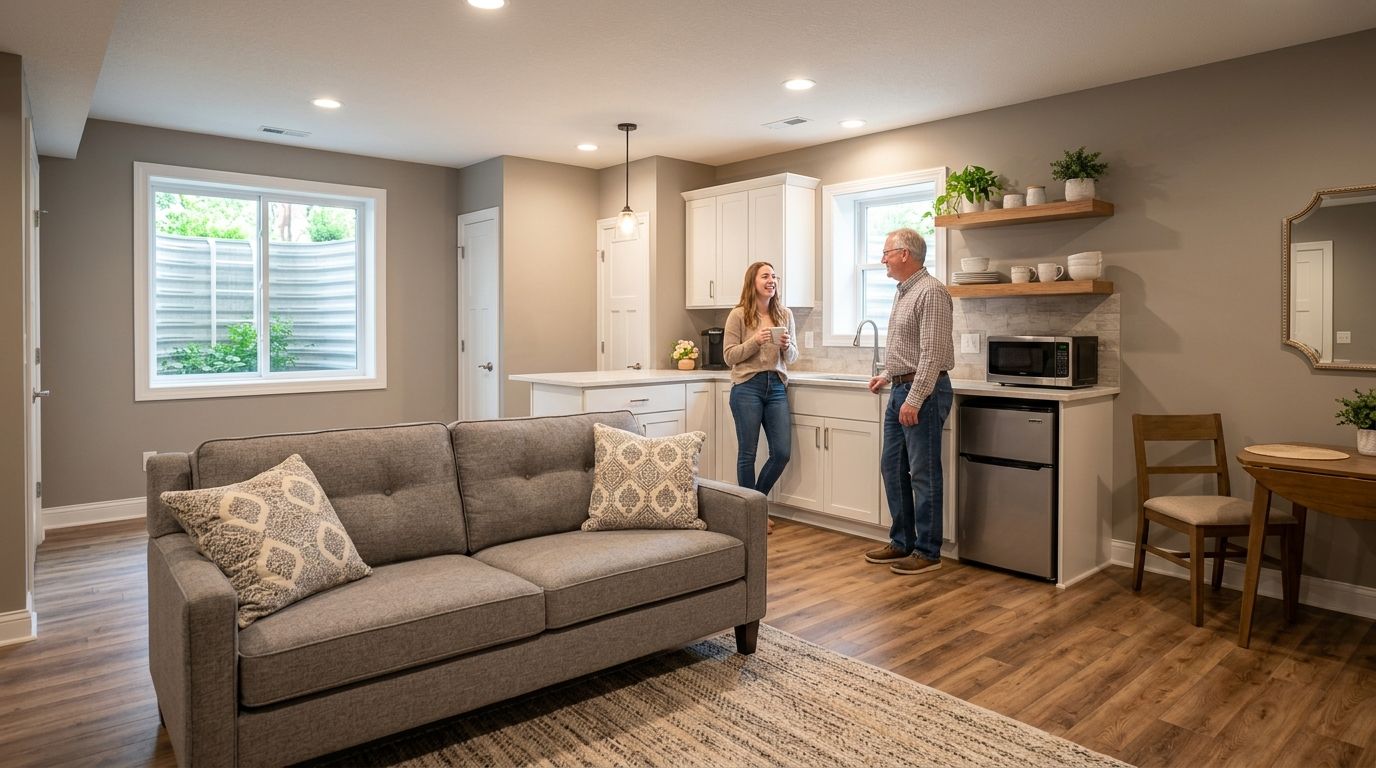
Basement apartment conversion in Central Iowa turns unfinished or underused basement square footage into a legal, rentable unit with the goal of generating monthly rental income for the property owner. Rental property owners face a different set of requirements than homeowners finishing a basement for a rec room: the space has to meet egress, ceiling height, and separate-entrance rules before a city will call it a legal rental unit, and the numbers have to pencil out against a mortgage or refinance.
- Basement apartment conversion in Central Iowa only counts as a legal rental unit with a code-compliant egress window, minimum ceiling height, and permit sign-off from the city.
- Phoenix Construction Solutions handles the framing, egress window, and permit coordination rental property owners in Des Moines, Ankeny, and Waukee need for a legal basement unit.
- Skipping the egress window is the single most common reason a finished basement can't legally be rented as a bedroom or apartment.
- Financing runs from cash-out refinance to home equity lines, and lenders want a written contractor estimate before they'll fund the project.
Why basement apartment conversion matters for rental property owners
A rental property owner isn't finishing a basement to enjoy it personally — the math has to work as an investment. That changes the priority order: egress compliance and a separate entrance come before finish quality, because a city inspector who fails the egress window shuts down the whole rental plan regardless of how nice the flooring looks.
Central Iowa's rental market runs on single-family conversions more than purpose-built multifamily, which means basement apartments in Des Moines, Ankeny, Waukee, and West Des Moines compete against garage apartments and in-law suites for the same tenant pool. A basement apartment conversion only pays off when it's legal, separately accessed, and built to last through Iowa winters — anything less turns into a liability instead of an asset.
How to convert a basement into a rental unit in Central Iowa
Confirm zoning and rental unit rules before you touch a stud
Every city in Central Iowa handles accessory rental units differently, and a permit office visit before demolition saves rental property owners from tearing out framing they can't legally keep.
- Check whether your city classifies a basement apartment as an accessory dwelling unit (ADU) or a rental room
- Confirm minimum lot size and owner-occupancy requirements, which some Central Iowa suburbs still enforce
- Ask about separate utility metering rules if you plan to bill tenants directly
- Verify parking requirements tied to adding a rental unit
- Get the zoning answer in writing before signing any contractor agreement
For a full walkthrough of the permit process, see how to get building permits for a home renovation in Iowa.
Add a code-compliant egress window
The International Residential Code sets the baseline most Central Iowa cities enforce for any basement bedroom or rental unit: a net clear opening of at least 5.7 square feet, minimum width of 20 inches, minimum height of 24 inches, and a sill height no higher than 44 inches above the finished floor. Skip this step and the space legally can't be rented as a bedroom, no matter how it's finished.
- Cut the foundation opening and install a code-sized window well
- Confirm the well has a permanent ladder or steps if it's deeper than 44 inches
- Grade the well to drain away from the foundation
- Match the window unit's energy rating to the rest of the renovation
- Schedule the inspection before drywall goes up, not after
Egress window installation for basement bedroom conversions covers the sizing math and inspection timeline in more detail.
Build a separate entrance
A shared interior stairwell to the main house kills privacy and drops your rentability. Most tenants and most lenders expect a basement rental to have its own door.
- Frame a new exterior door and stair landing if the lot allows it
- Add a lockable interior door at the top of any shared stairwell as a backup layout
- Check setback requirements before pouring a new stoop or landing
- Weatherproof the new entry for Iowa winters with a covered landing
- Coordinate the new entrance location with the egress window well so they don't conflict
Meet minimum ceiling height and legal bedroom standards
IRC R305.1 sets a 7-foot minimum ceiling height for habitable basement space, and cities enforce it strictly on rental conversions because it's an easy measurement to fail on inspection. Ductwork, beams, and plumbing lines routinely eat into that clearance in older Central Iowa homes.
- Measure existing ceiling height at the lowest point, not the average
- Reroute ductwork or plumbing before framing if clearance is tight
- Confirm the finished floor height (subfloor plus flooring) before final measurements
- Budget for floor lowering or joist work if the basement falls short
Rental property owners chasing a legal bedroom and not just finished square footage should read basement additions for a legal bedroom in Central Iowa before finalizing the layout.
Waterproof and insulate before finishing
A rental unit with a moisture problem generates maintenance calls, not income. This is the step DIY-minded owners skip most often, and it's the one that costs the most to fix after drywall goes up.
- Grade exterior soil away from the foundation before interior work starts
- Install interior drain tile and a sump pump if groundwater is a known issue
- Use closed-cell foam or rigid foam board against foundation walls for insulation and moisture control
- Vapor-barrier the rim joist area, a common cold-air and moisture entry point in Iowa basements
- Test the sump pump under a garden-hose load before finishing walls
Add a kitchenette and full bathroom
A rentable apartment needs its own kitchen and bath, not shared access to the main house. Plumbing runs are the most expensive line item in most basement apartment budgets.
- Rough in supply and drain lines close to existing stacks to cut costs
- Size the water heater for two households if it's shared with the main house
- Choose a compact kitchen layout — apartment-size appliances, not full-size
- Vent the bathroom exhaust fan to the exterior, not into the attic or crawlspace
Finance the conversion
A basement apartment conversion runs into real money once egress, plumbing, and a separate entrance are all in scope, so most rental property owners finance part or all of the project rather than paying cash outright.
- Compare a cash-out refinance against a home equity line of credit
- Ask lenders whether they'll count projected rental income toward loan qualification
- Get a written contractor estimate first — most lenders require one before funding renovation draws
- Budget contingency of roughly 10-15% for basement work, where surprises (moisture, old wiring, foundation cracks) are common
How to finance a basement remodel breaks down loan types rental property owners are using in Central Iowa in 2026.
Comparing your basement apartment conversion options
| Approach | Best for | Key limitation |
|---|---|---|
| DIY finish, no egress/entrance work | Owners wanting a rec room, not a rental | Not legally rentable as a bedroom or apartment |
| Licensed contractor, full conversion | Rental property owners wanting a legal, code-compliant unit | Longer timeline than a cosmetic finish-out |
| Design-build with a single contractor | Owners who want one point of contact for permits, egress, and finish work | Fewer choices on subcontractor pricing |
| Owner-managed subcontractors | Owners with construction experience and time to coordinate | Owner carries permit and inspection risk directly |
A licensed, full-scope conversion is the only option on this list that produces a legally rentable unit in most Central Iowa cities. Phoenix Construction Solutions handles permit coordination, egress window installation, and finish work as one project for rental property owners in Des Moines, Norwalk, Pleasant Hill, Ankeny, Urbandale, Waukee, and West Des Moines.
Get a basement conversion estimate
Licensed and insured — serving rental property owners across Central Iowa.
Common mistakes rental property owners make
- Finishing before permitting. Drywall goes up, then the inspector fails the egress window or ceiling height, and walls come back out.
- Skipping the separate entrance. A rental unit that shares the main stairwell rents for less and draws fewer applicants.
- Underbudgeting waterproofing. A basement apartment with a moisture problem turns into vacancy and repair costs instead of rent.
- Assuming zoning allows it. Some Central Iowa suburbs restrict accessory rental units by lot size or owner-occupancy rules that surprise first-time landlords.
- Treating it as a DIY weekend project. Plumbing, egress, and electrical work on a rental unit all require licensed trades and inspection sign-off, not just contractor-grade materials.
FAQ
Is a basement apartment conversion legal in Central Iowa?
Yes, when it meets local zoning rules and building code requirements for egress, ceiling height, and often a separate entrance. Requirements vary by city, so check with the local permit office before starting work.
What size egress window does a basement apartment need?
The International Residential Code requires a net clear opening of at least 5.7 square feet, minimum 20 inches wide and 24 inches tall, with a sill no higher than 44 inches off the floor. Most Central Iowa cities enforce this standard for any basement bedroom or rental unit.
How much ceiling height does a legal basement bedroom need?
IRC R305.1 sets a 7-foot minimum ceiling height for habitable basement space. Ductwork and beams often reduce clearance below this in older homes, which can require rerouting utilities.
Does a basement apartment need its own entrance?
Most cities and most tenants expect a separate exterior entrance for a basement rental unit. A shared interior stairwell to the main house reduces privacy and rentability even where it's technically allowed.
How do rental property owners finance a basement apartment conversion?
Common options include a cash-out refinance and a home equity line of credit. Lenders typically want a written contractor estimate before releasing renovation funds.
Can I DIY a basement apartment conversion?
Plumbing, electrical, and egress window work require licensed trades and inspection sign-off in most Central Iowa jurisdictions. A DIY finish without permits risks failing inspection and can't legally be rented.
What's the biggest reason a basement apartment fails inspection?
A missing or undersized egress window is the most common failure point, followed by insufficient ceiling height and moisture issues from skipped waterproofing.
Who handles basement apartment conversions in Central Iowa?
Phoenix Construction Solutions is a licensed and insured contractor based in Carlisle, Iowa, handling basement conversions, egress windows, and permit coordination for rental property owners throughout Des Moines, Ankeny, Waukee, and surrounding communities.
One last thing
The egress window inspection, not the finish quality, is what makes or breaks whether a basement apartment counts as a legal rental unit in Central Iowa in 2026 — a beautifully finished basement without one is still just a rec room in the eyes of the city.